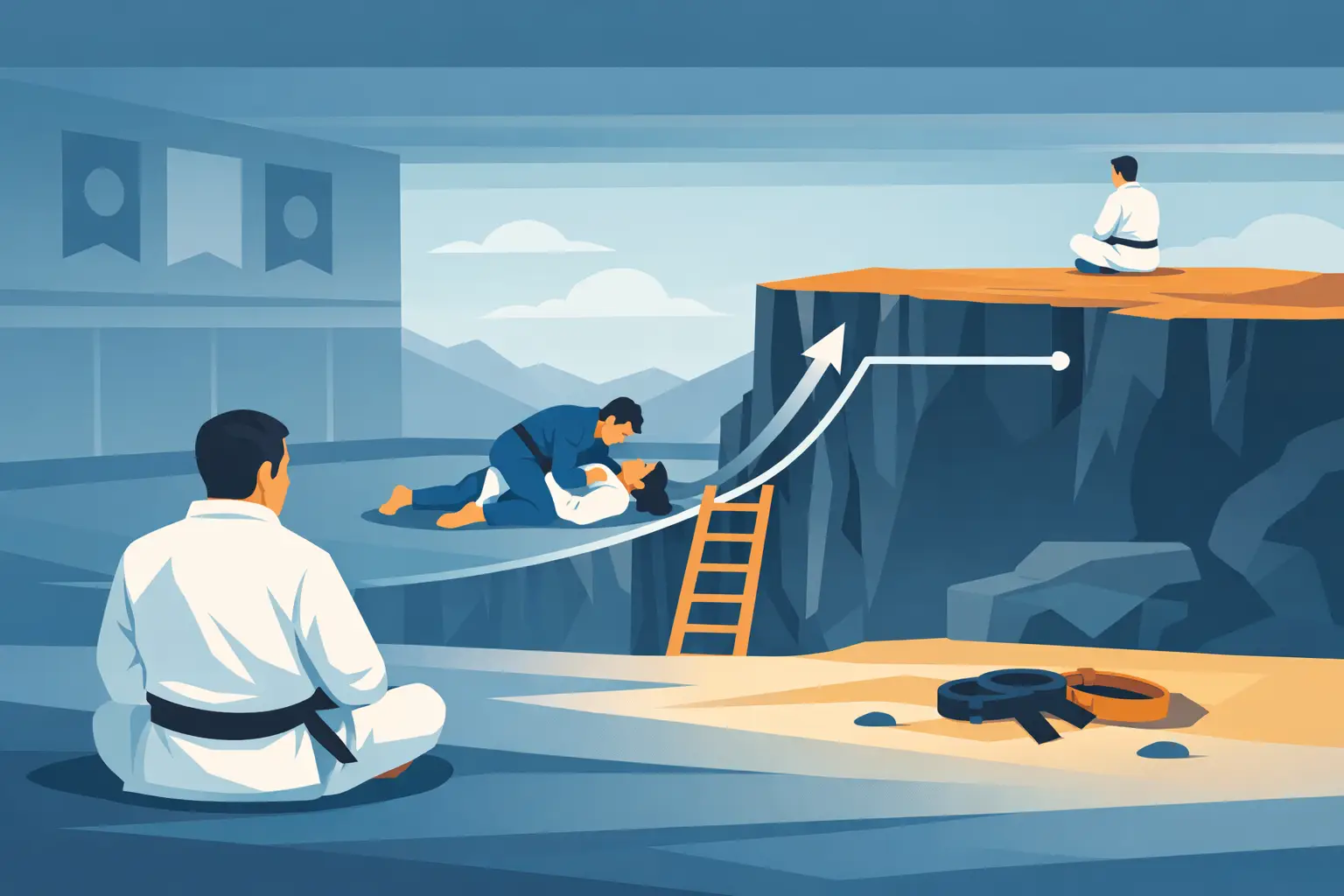
A student who was improving every month suddenly looks unchanged. They know more techniques, attend consistently, and may even be training harder, yet the same positions still create the same bad decisions. They force a pass that used to work, freeze under pressure, or repeat a familiar escape without solving the actual problem. Why do BJJ students plateau? Often, the issue is not effort or toughness. It is the relationship between the athlete, the training environment, and the feedback system around them.
For coaches, a plateau should be treated as useful information. It reveals that the current class design is no longer producing enough new perception, decision-making, or adaptation for that athlete. The answer is rarely to add more moves to the curriculum. It is to examine what the student is repeatedly being asked to notice, solve, and adjust.
Why Do BJJ Students Plateau in Otherwise Good Classes?
A technically competent class can still produce limited learning transfer. Students may rehearse a sequence cleanly with a cooperative partner, understand the verbal details, and demonstrate it correctly at the end of class. Then live training changes the timing, posture, pressure, angle, and emotional stakes. The technique disappears because the student did not develop the ability to identify when, why, and how to use it against real resistance.
This is where coaches can confuse activity with adaptation. A room can be busy, disciplined, and full of drilling while athletes remain dependent on the coach's script. If the same response is rehearsed against the same look every week, students become efficient at recognizing the exercise rather than becoming better at grappling.
Plateaus also show up differently by experience level. A newer student may plateau because every round feels chaotic and they cannot yet identify reliable anchors such as inside position, head position, or distance. An intermediate student often plateaus because familiar patterns have become default answers. A more advanced athlete may plateau because the room no longer presents enough resistance quality, stylistic variety, or specific problems to challenge their existing game.
The coaching response should fit the athlete. More information can help a beginner, but it can overwhelm them as well. More variability can challenge an intermediate athlete, but it must still preserve a clear problem. High-level athletes may need narrower, more demanding tasks rather than a broader collection of techniques.
The Most Common Design Problems Behind a Plateau
Students practice solutions before they understand the problem
Many lessons begin with a prescribed answer: a grip, a sequence, an escape, or a finish. The student is told where to place their body before they have experienced the positional problem that makes that choice useful. They can copy the shape, but they have not learned the cues that should trigger it.
A better progression may begin with the problem itself. In a guard retention game, for example, the defender may have a simple objective to keep their feet and knees between themselves and the passer while the passer tries to establish chest-to-chest control. The athlete begins to experience distance, angle, hip movement, and connection before being directed toward a particular retention pattern. Technical language can still be valuable, but it has more meaning after the athlete has encountered the need for it.
Resistance is either too predictable or too overwhelming
Predictable repetitions create confidence, but confidence without adaptation is fragile. Conversely, starting every task at full intensity can make the athlete revert to survival habits before they have a chance to explore better options.
Effective practice controls the level and type of resistance. A coach can constrain a round by limiting starting positions, defining scoring conditions, adjusting available grips, setting time limits, or giving one athlete a positional advantage. These are not arbitrary rules. They shape the information the athlete must respond to.
For example, if a student is struggling to escape side control, beginning every round flat under full pressure may only reinforce poor framing and panic. Start with a defined objective such as recovering an elbow-knee connection or getting to a hip. As the student finds workable actions, increase the opponent's freedom and intensity. The task should be difficult enough to demand adaptation, but clear enough that athletes can recognize what improved.
The class has no mechanism for tracking recurring problems
A plateau becomes prolonged when it is treated as a vague feeling. Students say they are "stuck," and coaches respond with general encouragement or another technique from the same position. Without session notes, game outcomes, athlete observations, or curriculum records, patterns disappear as soon as class ends.
Coaches need a simple operational record of what happened. Which games produced productive rounds? Where did students consistently stall? Which constraints led to better defensive posture? Did the task challenge the intended skill, or did athletes find an unintended shortcut? These observations turn class delivery into an evolving coaching system rather than a series of disconnected sessions.
ConstraintCoach is built around this type of workflow: organizing games, lesson plans, session logs, and curriculum assets so instructors can identify what is actually working across classes rather than relying only on memory.
Feedback tells athletes what to do, but not what to notice
Constant instruction can make athletes coach-dependent. If every pause includes a correction and every exchange has one approved answer, students wait for external direction instead of learning to regulate their own performance.
Feedback should help athletes attend to useful information. Instead of saying, "Use the underhook," a coach might ask, "What changed when their shoulder crossed your centerline?" Instead of saying, "Do not let them pass," ask, "Where were your knees when they controlled your hips?" The goal is not to eliminate direct coaching. It is to make direct coaching more precise and less likely to replace the athlete's own problem-solving.
Build Classes That Create Adaptation, Not Repetition
A constraint-led approach does not mean abandoning technical instruction or allowing unstructured sparring to do all the teaching. It means designing the environment so athletes repeatedly encounter the information and decisions that define functional jiu-jitsu.
Start by identifying the skill you want to improve in observable terms. "Improve guard passing" is too broad for one class. "Create chest-to-chest connection from headquarters before the bottom player recovers inside position" is more actionable. It gives both athletes a clear objective and gives the coach something specific to observe.
Then build a progression around representative tasks. A productive session may move from a narrow game with limited options to a more open game that preserves the same central problem. If the objective is controlling the far hip during a pass, early rounds might begin with established leg control. Later rounds can begin from a more neutral engagement where athletes must first create that control.
The transfer between tasks matters more than novelty. Games should connect to one another, with each constraint emphasizing a feature the student will need in the next phase. Randomly rotating through fashionable games can be as fragmented as randomly rotating through techniques.
A useful planning process is to define four elements before class:
- The positional context and starting conditions.
- The objective each athlete is trying to achieve.
- The constraints that direct attention toward the intended problem.
- The observable behaviors that indicate progress.
This structure helps assistant coaches deliver the same training intention, even when they use slightly different language. It also makes it easier to review a session afterward and refine it rather than rebuilding from scratch next week.
How to Diagnose a Student Plateau on the Mat
When a student appears stuck, avoid assuming the problem is motivation. Watch several rounds and look for the actual failure point. Are they failing to perceive an opening? Are they seeing it but arriving late? Do they have a workable action but abandon it under resistance? Or are they using an action that works against one training partner but not against different body types and styles?
These distinctions lead to different interventions. An athlete who cannot recognize the opening needs a task that makes the relevant cue more visible. An athlete who recognizes it too late may need more repetitions with changing timing. An athlete who panics under pressure may need a smaller game with a survivable objective and enough rounds to build confidence. An athlete who succeeds only in familiar conditions needs broader variation, not another explanation of the same move.
Video, session logs, and brief athlete reflections can support this process, but the coach does not need to turn every class into a data project. The standard is practical: collect enough information to make the next session more intentional than the last one.
Plateaus Are a Coaching Design Signal
Some plateaus are normal. Learning is uneven, and athletes occasionally need time for physical development, recovery, or a new pattern to stabilize. A coach should not redesign the curriculum every time a student has one bad week.
But a long plateau across multiple athletes is usually a signal. It may indicate that the class has become too predictable, too technique-centered, too open-ended, or too poorly connected from game to game. The solution is not necessarily more intensity. Often it is better task design, clearer objectives, and a more reliable method for recording what the room is teaching.
The next time a capable student seems stuck, give them a problem worth solving rather than another answer to memorize. A well-designed constraint can make the next useful decision visible, and that is often where progress starts moving again.