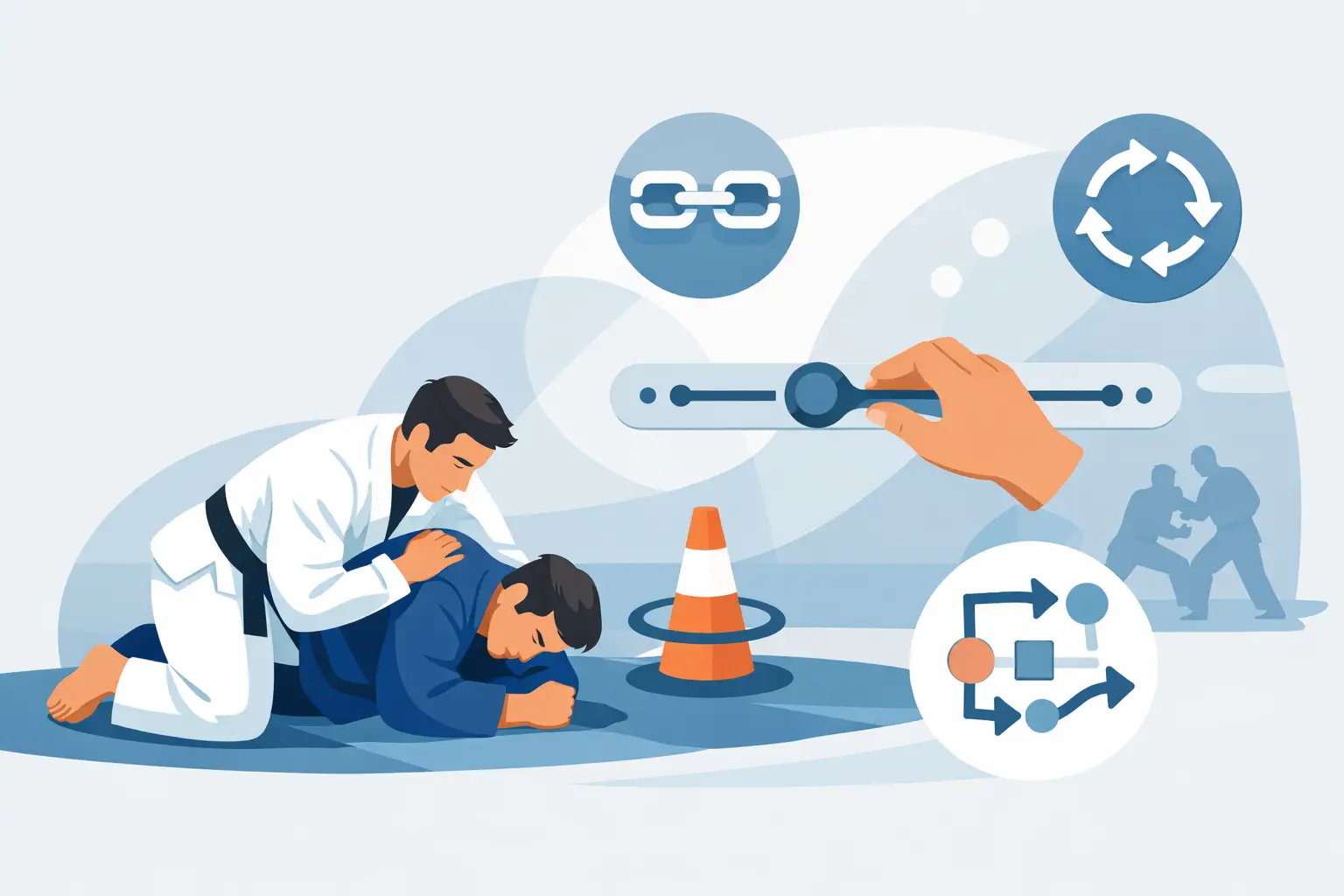
A passing game stalls in the same place three rounds in a row. The bottom player frames, turns away, and waits for a reset. The coach sees the problem, removes a barrier, adds a time limit, and suddenly the game looks different. But did learning improve, or did the new rule simply make the old answer impossible? That is the real question behind when should coaches change constraints in BJJ.
Changing a constraint is not a reward for effort, a punishment for failure, or a way to make class feel fresh. It is an intervention in the learning environment. Every change alters what athletes notice, which actions become available, and which decisions are worth trying. Good coaches make those changes with a clear reason. Great coaches also know when to leave the game alone.
When Should Coaches Change Constraints in BJJ?
Coaches should change constraints when the current game no longer creates the information or behaviors they intended to train. That can happen because the task is too easy, too difficult, unsafe, overly predictable, or producing solutions that do not transfer well to the target situation.
The key is to observe behavior before altering the task. A constraint is not failing because athletes lose, get stuck, or look messy. In a well-designed game, struggle is often the point. The issue is whether that struggle is productive. Are athletes searching, adjusting posture, testing timing, and discovering options? Or are they repeatedly disengaging, freezing, brute-forcing, or exploiting a loophole that bypasses the skill you want to develop?
A coach who changes rules too quickly can interrupt adaptation. A coach who waits too long can allow poor task design to become the lesson. The practical skill is learning to distinguish productive variability from an environment that has stopped teaching.
Start With the Intended Behavior
Before deciding whether to adjust anything, define what the game is designed to bring out. “Work on guard passing” is too broad. A more useful objective might be: create pressure that limits the bottom player’s hip movement, recognize when the opponent’s frames weaken, and progress past the legs without conceding inside position.
That objective gives you something concrete to watch. If players are reaching for low-percentage grips, backing away, or winning only through a rule-specific tactic, the game may not be presenting the right problem. If they are fighting for head position, managing distance, and changing directions as frames appear, the game may be doing its job even when nobody looks polished.
Constraints should serve the representative problem, not a preferred technique. A rule that forces every passer into one passing pattern may create neat-looking repetitions, but it can remove the perception and decision-making that make passing functional against resistance. Instead, shape the environment so athletes have reasons to solve the problem in better ways.
Four Signals That a Constraint Needs Adjustment
There are four common signals that merit a change: the game is too easy, too hard, too distorted, or no longer safe. These are diagnostic categories, not automatic instructions. The right adjustment depends on the behavior you want to preserve.
The task is too easy
A game is too easy when one player can achieve the objective with little need to perceive, adapt, or manage meaningful resistance. This often appears when the starting position gives one athlete such a large advantage that the round becomes a sequence of predictable finishes or escapes.
For example, if a passer begins already chest-to-chest on a flattened half guard player and clears the legs immediately, the bottom player may receive too few opportunities to recover position. Rather than simply telling the passer to go slower, adjust the starting relationship. Give the bottom player an active frame, a knee shield, or a more viable connection. The passer now has a real problem to solve.
The task is too hard
A task is too hard when athletes cannot access the actions needed to explore the objective. They may freeze, resort to reckless movement, or repeatedly fail before meaningful interaction develops. This is especially common when a game asks newer athletes to solve a late-stage problem without enough usable time or position to perceive what is happening.
The answer is not always to simplify the game by removing resistance. You can scale the task by changing space, starting distance, time to score, or the number of available pathways. If players cannot escape mount because the top player starts fully settled and has unlimited time, begin with an active frame or a partially developed mount. Keep the essential pressure of the problem while making exploration possible.
The task is producing a distorted solution
This is one of the most important reasons to change constraints. Athletes are adaptive. If a rule can be gamed, they will find the shortest route to winning it. That is not athlete misconduct. It is feedback about the task.
Suppose a guard retention game awards the bottom player for keeping both feet between themselves and the passer, but does not account for exposure of the upper body. Players may lie flat, extend their legs, and ignore the grips, angle changes, and upper-body connections that matter in live passing. The scoring condition has selected a behavior that is technically compliant but strategically weak.
When that happens, do not lecture athletes into following the invisible version of the game in your head. Change the design. Add a scoring condition that reflects meaningful passing progress, narrow the usable space, or alter the initial alignment so the unwanted solution loses value.
Safety or intensity has drifted
Constraints also need changing when the game reliably produces unsafe collisions, uncontrolled submissions, or intensity that overwhelms the intended learning. This is not an argument for making every game gentle. BJJ requires athletes to experience pressure, urgency, and physical consequences. But the task should match the group’s skill level and the day’s objective.
A crowded takedown game with unrestricted entries may be appropriate for experienced competitors with clear boundaries. It may be a poor choice for a mixed room after a hard conditioning block. Reduce the space, limit the entry type, use wall starts, or shift the objective toward off-balancing and connection rather than finishing takedowns. Safety constraints are part of task design, not an administrative afterthought.
Change One Variable Before Changing the Whole Game
When a game misses the mark, coaches often rewrite it completely. That makes it difficult to learn what caused the improvement. A more disciplined approach is to change one meaningful variable, observe the new behavior, and record the result.
You might adjust the starting position, available space, scoring condition, round duration, athlete pairing, or the actions that trigger a reset. Each variable changes the game differently. Smaller space tends to increase contact and urgency. More space may create earlier perception and movement choices. A shorter round can encourage immediate engagement, while a longer round may reward pacing and layered problem-solving.
Do not confuse novelty with progression. A game does not need a new rule every round. Progression can come from better athlete adaptation within stable conditions. If the intended behavior is emerging and athletes are still finding different answers, hold the constraint steady long enough for those answers to be tested.
Use Questions Before Rule Changes
A coach’s questions can reveal whether the game needs adjustment or whether athletes need time to recognize better information. After a round, ask what made the pass work, what caused the escape to fail, or where control was lost. Keep the questions tied to the task, not to a preselected technique.
If athletes can identify relevant cues but struggle to act on them, the current constraint may be appropriately challenging. Give them another round. If they cannot identify any useful information because the game has become chaotic or irrelevant, redesign is more likely needed.
This distinction matters. Coaching every problem with a new rule can make athletes dependent on external direction. Asking targeted questions preserves ownership while helping them attend to the relationships that matter.
Build Constraint Changes Into Your Coaching System
The strongest class design does not rely on memory after a busy session. Track each game’s objective, starting conditions, common athlete solutions, unintended loopholes, and the adjustments that improved the outcome. Over time, this becomes a practical library of tested decisions rather than a collection of interesting drills.
ConstraintCoach can support that workflow by keeping games, lesson plans, session logs, and coaching observations in one organized system. The value is not merely having more games available. It is being able to see which version of a game worked for beginners, which adaptation helped competitors, and which constraint repeatedly created poor behavior.
Review those notes before teaching the game again. You may find that the original design was effective, but the athlete group, class size, or session placement changed its demands. Constraints are relational. A useful game for a rested advanced room can become a poor fit for a beginner-heavy class at the end of the evening.
The next time a round looks messy, resist the urge to fix it immediately. Watch for the behavior the game is selecting, decide whether that behavior serves the target problem, and change only what the athletes need to perceive and solve it more effectively.