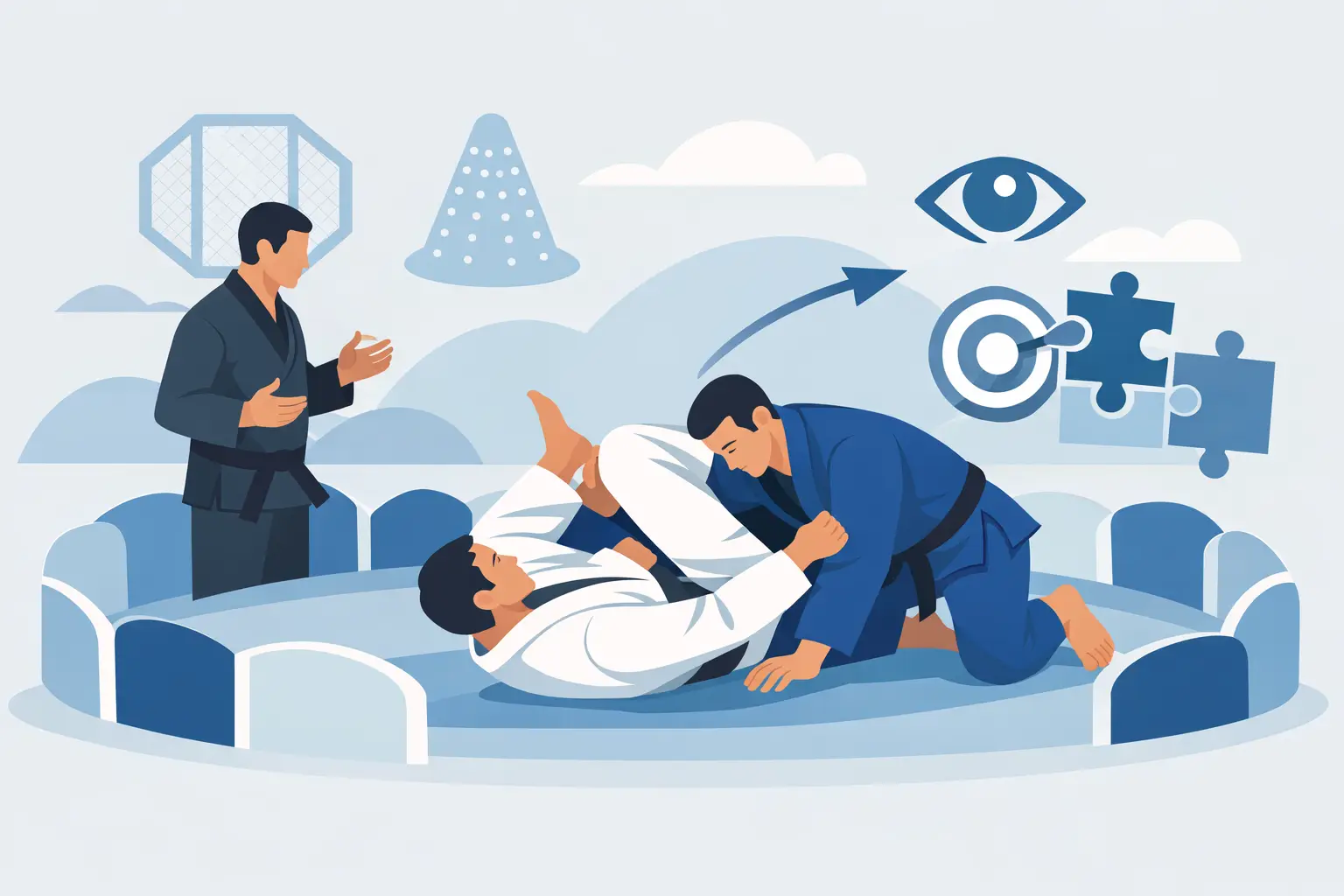
A student escapes side control cleanly during a live round after struggling with the position for weeks. The breakthrough did not come from another lecture on frames or a longer line of repetitions. It came from a game that made poor inside positioning immediately costly and made effective framing the most available solution. That is the practical answer to what is constraint led coaching: designing practice conditions that guide athletes toward useful actions without prescribing every movement.
In BJJ, the approach is usually referred to as the constraints-led approach, or CLA. It treats learning as an active process of solving movement problems. Rather than asking students to reproduce a fixed technique exactly as demonstrated, the coach shapes a problem, sets meaningful boundaries, and lets athletes search for solutions that work against a resisting partner.
What Is Constraint Led Coaching in BJJ?
Constraint-led coaching is a method of skill development built around representative games, live problems, and carefully selected constraints. A constraint is simply a condition that changes what actions are available, attractive, or effective.
For a BJJ coach, that might mean beginning an escape round with the bottom player already controlling an underhook, limiting the top player to a specific control, shrinking the available space, or awarding points only when a player improves position after maintaining connection. None of these conditions tells the athlete exactly how to move. They shape the environment so certain decisions become more useful and others become less useful.
The goal is not to remove instruction. Good coaches still observe, question, demonstrate when needed, and give feedback. The shift is in the primary learning task. Students spend less time copying a sequence in isolation and more time perceiving pressure, timing, posture, grips, space, and opponent reactions while making decisions.
That matters because jiu-jitsu is not performed against a cooperative partner who pauses at each checkpoint. It is a constantly changing interaction. A training method should preserve enough of that interaction for athletes to learn what a position actually feels like and what a successful decision costs.
The Three Types of Constraints
Coaches typically work with task, environmental, and individual constraints. These categories are useful because they make game design more deliberate instead of relying on random rules or increasingly complicated drills.
Task constraints
Task constraints are the rules, objectives, starting positions, scoring systems, and permitted actions within an activity. They are often the most direct tool for a BJJ instructor.
For example, a guard retention game may give the passer a point for clearing both legs and establishing chest-to-chest control, while the guard player scores for recovering inside position or returning to a stable guard. If the objective is to develop leg pummeling, the coach might require the bottom player to reconnect both feet before they can attack. The rule directs attention toward the desired problem without requiring every athlete to use the same retention pattern.
Task constraints should be clear enough that students know what they are trying to solve. Overloading a game with rules usually creates confusion, compliance, and dead training time. One strong constraint is often more productive than five clever ones.
Environmental constraints
Environmental constraints change the physical setting. Mat space, wall access, round duration, starting distance, and partner arrangement all affect behavior.
A small square can create more immediate contact and force athletes to manage pressure. A wall can make wrestling entries, pin escapes, and standing resets more representative of academy or competition situations. Short rounds increase the frequency of starts and decisions, while longer rounds expose whether athletes can sustain their solutions under fatigue.
Environmental changes are powerful, but they are not automatically useful. Reducing space may improve connection in a body-lock game, yet it may also remove the movement options needed for an open-guard objective. The environment should support the skill problem, not merely make training harder.
Individual constraints
Individual constraints account for the athlete in front of you: experience, size, mobility, confidence, injury status, technical history, and current developmental needs.
A new student may need a constrained starting position that gives them enough success to recognize the problem. An experienced competitor may need fewer restrictions, more ambiguity, or a stronger partner challenge. A smaller athlete working against pressure may benefit from a game that rewards angle creation and connection rather than forcing them to solve a problem through strength.
This is one reason constraint-led coaching is not a collection of games copied from a spreadsheet. The game is only useful when the coach can adjust its conditions to fit the group.
Why Games Improve Skill Transfer
Static drilling can be useful for introducing a movement, reducing fear, or giving students a first physical reference. The limitation appears when static repetition becomes the entire learning system. Students may remember the steps of an armbar but fail to recognize when the armbar is available, how the opponent is disrupting it, or which adjustment restores the opportunity.
Well-designed games preserve perception and action together. Athletes learn to see an opening, act on it, feel the opponent's response, and adapt. That loop is central to live grappling.
Games also give coaches better information. In a compliant drill, nearly everyone can look competent. In a constrained round, recurring errors become visible. Are students losing inside position because they are reaching? Are they conceding head position before they attempt a takedown? Are they framing correctly but failing to create the angle that makes the frame useful? The coach can identify the actual bottleneck rather than correcting the last technique demonstrated.
The trade-off is that learning can look less tidy. Different students may arrive at different solutions, and not every round produces an obvious technical win. That is normal. The standard is not visual uniformity. The standard is whether the practice is producing more effective, adaptable behavior in the target situation.
How to Design a Constraint-Led BJJ Game
Start with a specific performance problem, not a technique name. “Students need better side-control escapes” is broad. “Bottom players are losing the inside elbow position before creating space” is a coachable problem.
Next, define the representative situation. Decide where the round begins, what each player is trying to achieve, and what normal resistance belongs in the task. If you remove too much resistance, the game becomes a disguised drill. If you add too much complexity before students can engage with the problem, the game becomes chaotic.
Then select the smallest constraint likely to influence behavior. You might give the top player points for consolidating an underhook and the bottom player points for recovering an elbow-knee connection. Run the game, observe several rounds, and ask whether the rule is producing the behavior you intended.
Finally, adjust based on what you see. If the bottom player has no viable path to success, make the starting position less oppressive or change the scoring. If the desired behavior appears immediately and becomes automatic, remove support and increase realism. Progression is not always adding more rules. Often, it means taking away a training aid once it has done its job.
The Coach's Role Is More Demanding, Not Less
A common misunderstanding is that constraint-led coaching means the instructor steps back and lets students “figure it out.” That is not disciplined coaching. It is abdication.
The coach's work moves upstream into task design and becomes more active during observation. You need to recognize the key information in a position, identify what athletes are currently doing, choose a constraint that changes the problem productively, and know when not to interfere. Questions such as “What changed when you lost inside position?” or “What was your partner doing before the pass became easy?” can direct attention without replacing discovery with a speech.
This also requires an organized coaching system. A useful game should be recorded with its objective, starting position, constraints, scoring, safety notes, regressions, progressions, and observations from class. Without that structure, effective games get forgotten and curriculum delivery becomes inconsistent. A platform such as ConstraintCoach can help instructors build a reusable library and track how games perform across classes rather than rebuilding sessions from memory each week.
Common Mistakes When Using Constraints
The first mistake is treating every restriction as a constraint-led activity. Telling students they can only use one submission may create variety, but it does not necessarily improve the target skill. The rule must connect directly to the behavior or information you want athletes to explore.
The second is using games without a defined learning objective. Competitive rounds are valuable, but competition alone does not organize development. A game needs a clear problem and scoring that reflects meaningful progress.
The third is ignoring safety. Constraints can create intense scrambles, repeated exposure to loaded positions, or incentives to force a finish. Set appropriate tap expectations, reset rules, intensity standards, and partner pairings. A good game protects enough freedom for learning without rewarding reckless behavior.
Constraint-led coaching becomes effective when it is treated as a design discipline. Build a clear problem, create conditions that make better decisions available, observe the response, and refine the next version. Over time, your classes become more than a sequence of techniques - they become a system for developing athletes who can solve jiu-jitsu in front of them.