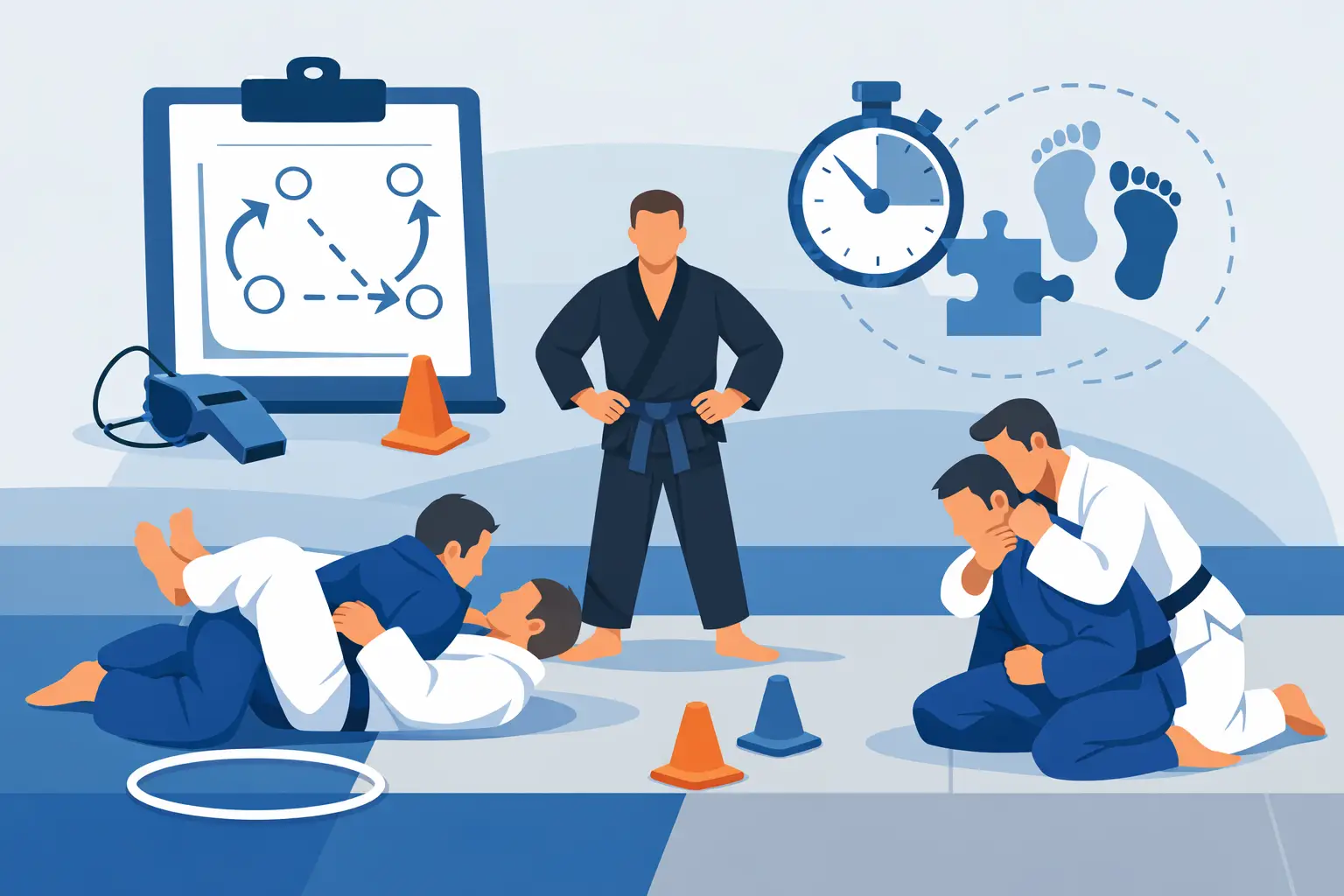
A game is not constraint-led because it has a catchy name or because athletes are sparring from a specific position. The top constraint led BJJ games give students a real problem to solve, shape the information available to them, and preserve enough freedom for individual solutions to emerge. That is what makes them useful for coaches who want better transfer from class to live rounds.
For an instructor, the standard should be higher than whether a room looks active. A productive game should reveal decisions, create repeated interactions around a tactical theme, and give the coach observable behaviors to assess. If athletes can win through the same shortcut every round, the design needs adjustment.
What Makes a Constraint-Led BJJ Game Worth Keeping?
The best games are not collections of techniques disguised as sparring. They are representative tasks: the starting position, goals, boundaries, time pressure, scoring, and partners recreate the important information of the larger BJJ problem.
A passing game, for example, should not merely tell the top player to pass and the bottom player to retain. It should expose distance management, angle creation, grips, hooks, frames, and the timing of re-attacks. The coach then uses constraints to direct attention toward the behaviors the group needs without scripting every movement.
There is always a trade-off. A highly constrained game can create fast repetition and make a lesson easier to manage, but it may narrow solutions too far. A more open game offers better adaptability, but inexperienced students may not encounter the target problem often enough. Strong class design moves between those two ends deliberately.
Before running any game, identify three things: the tactical problem, the behaviors that suggest progress, and the constraint that will make those behaviors more likely. This keeps the session organized around learning rather than activity.
Top Constraint Led BJJ Games for Class Design
1. Inside Position Passing Race
Start with the bottom player seated or in a supine open guard with both feet and at least one hand frame available. The top player begins outside the legs and scores by establishing a stable chest-to-chest side control or by pinning past the knees for three seconds. The guard player scores by recovering a meaningful inside position, such as both feet inside, a strong shin-to-shin connection, or a seated wrestle-up that forces the passer to disengage.
The key constraint is that the passer cannot initiate with a fully locked body-lock or settle into a static headquarters position for more than three seconds. This prevents athletes from stalling in a familiar posture and encourages them to manage the inside space dynamically.
Coach for whether the passer creates an angle before driving forward, and whether the guard player uses frames to recover space rather than simply pushing. For newer groups, shorten the starting distance. For advanced athletes, require the passer to complete the pass on a designated side before switching sides.
2. Guard Retention With a Shrinking Boundary
Place the round inside a small square marked by mats, tape, or clear verbal boundaries. The top player wants to pass and stabilize. The bottom player wants to retain guard, recover to seated guard, or force the top player outside the boundary. If either athlete steps out, reset with the bottom player in the best guard configuration they had before the exit.
The shrinking boundary changes the task. It rewards the bottom player for using hip movement, frames, and connection to manage pressure rather than endlessly scooting away. It also requires the passer to close distance without overcommitting and creating easy retention opportunities.
This is particularly useful when athletes have technically recognizable guard-retention movements but lose position the moment the exchange gets crowded. Do not make the space so small that the top player has no path to pass. The boundary should create contact-rich decisions, not eliminate movement.
3. Underhook Escape to Score Zone
Begin with the bottom player under a tight side-control or half-guard pressure scenario. Mark a score zone near the athletes' feet. The bottom player wins by getting to an elbow, knees, or standing base and reaching the zone with a meaningful connection, such as an underhook, a body lock, or a head-and-arm control. The top player wins by re-establishing chest-to-chest control for a five-count or transitioning to mount.
The underhook is not a mandatory technical instruction. It is an environmental invitation. By making connection and movement toward a space the scoring condition, athletes learn when the underhook helps them rise, when it exposes their back, and when a frame or hip escape is the better answer.
For less experienced athletes, begin with the top player’s weight partially displaced and limit transitions to side control. For experienced students, allow the top player to attack submissions or follow the escape into front headlock and back exposure. The game becomes more representative as the task expands.
4. Front Headlock Exit or Finish
Start with one athlete in a front headlock connection, but prohibit immediate submission attempts for the first five seconds. The front-headlock player scores by controlling behind the hips, taking the back, or finishing after the initial five-second period. The defending player scores by clearing their head, building a base, and establishing a neutral or attacking connection.
That initial delay matters. Without it, many athletes jump straight to a favorite guillotine or simply pull away from the position. The delay creates a hand-fighting and positional battle where head position, elbow control, hip distance, and movement become more visible.
Use this game to coach the transition between wrestling exchanges and submission grappling. Watch for defenders who expose their back while trying to escape and attackers who chase the neck while losing control of the hips. Those are useful coaching observations because they identify the actual breakdown, not just the final outcome.
5. Mount Survival With Connection Rules
Give the top player mount and a 45-second round. The top player scores for maintaining mount, progressing to high mount, isolating an arm, or completing a submission. The bottom player scores for getting to half guard, full guard, or standing. However, the bottom player cannot use explosive bridging as their first action after every reset. They must first establish a frame, elbow position, or meaningful connection to the top player.
This constraint removes the low-percentage habit of bridging without information. It encourages students to feel where the top player’s weight is, organize their arms, and create an escape sequence based on the pressure they receive.
The top athlete should also have a constraint. Require them to maintain at least one hand connected to the mat, chest, or a controlling grip before they can attack. This reduces reckless submission hunting and keeps the game centered on balance and pin control.
6. Back Escape Through Hand Separation
Begin with the attacker on the back using a seatbelt and one hook, or both hooks for advanced groups. The defender scores by separating the controlling hands and reaching a safe chest-to-mat or guard-facing position. The attacker scores by finishing, recovering a lost hook, or holding the seatbelt and chest-to-back connection for a designated count.
This game gives the defender a clear problem without reducing back escapes to a memorized sequence. They must recognize which hand is threatening, protect the neck, choose a side, and manage hooks while moving. The attacker learns that a seatbelt is not automatically secure if their hand position and chest connection deteriorate.
Avoid making the defender’s win condition simply “escape the back.” That is too broad for newer athletes. Hand separation is observable, repeatable, and directly related to the immediate survival task.
Build Games Into a Repeatable Session System
A strong game becomes more valuable when it is documented and tested across multiple classes. Record the starting position, win conditions, prohibited shortcuts, round length, athlete level, and the behaviors you observed. Afterward, note whether the constraint created the intended interactions or whether athletes found an unintended route to score.
This is where a structured coaching system matters. ConstraintCoach can help instructors organize games by position, objective, level, and curriculum block, then retain session notes instead of rebuilding the same class from memory. Over time, that creates a usable library of proven tasks rather than a collection of isolated ideas.
Run a game long enough for athletes to adapt. The first round often shows their default habits. The second and third rounds show whether they are finding new solutions. If you change the rules every few minutes, you may create novelty, but you lose the chance to see learning stabilize.
Use short coaching interventions between rounds. Name one pattern the room needs to notice, then let athletes test it immediately. A long technical explanation can pull attention away from the problem the game was designed to present.
The most useful constraint-led games are not the most elaborate. They make the right BJJ problem hard to avoid, give athletes room to solve it in different ways, and give the coach a reliable lens for deciding what to train next.