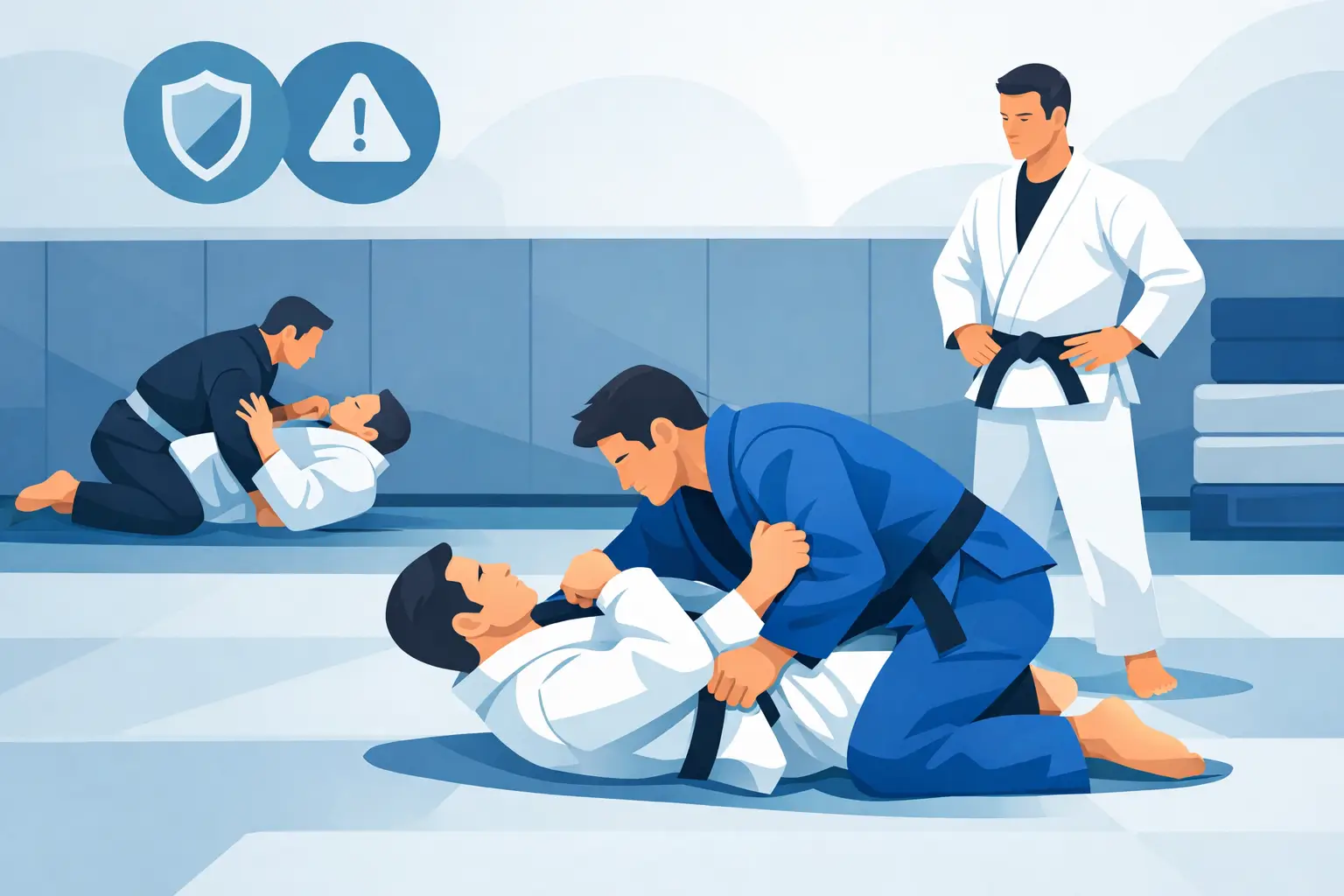
A round gets dangerous long before anyone is injured. It usually starts when a tired white belt is paired with a stronger partner, the task is vague, the pace rises, and neither athlete knows where the boundaries are. Coaches who run safer BJJ live rounds do not solve that problem by repeating “be careful.” They design the round so better decisions are the easiest decisions to make.
Safety and realistic learning are not competing goals. A well-built live task can preserve resistance, timing, pressure, and decision-making while reducing the chaotic situations that create preventable injuries. The key is to treat safety as part of game design, not as a reminder delivered after the round begins.
Safety starts with the task, not the warning
“Start from side control and roll” is not a complete task. It tells athletes where to begin, but it does not define what they are trying to solve, how hard they should pursue it, or what actions are outside the intended learning environment. That ambiguity encourages athletes to fill in the blanks with their usual habits, which often means escalating force.
A safer live round begins with a clear objective for each player. For example, the top player may be trying to maintain chest-to-chest control and progress to mount, while the bottom player is trying to recover inside position or stand up. This gives both athletes meaningful problems without turning every exchange into a submission hunt.
The constraints should also identify high-risk actions. If the session is about passing, you might remove heel hooks, jumping attacks, and fast inversions from the game. If the task begins in a leg entanglement, the rules need to be much tighter: define permitted grips, the acceptable finishing range, the expected release response, and the exact conditions for a reset.
This is not about making jiu-jitsu artificial. It is about matching the risk profile to the athletes, the learning objective, and the time available. A competition-focused advanced group can operate with broader constraints than a mixed-level evening class. The coach’s job is to make that distinction deliberately.
How to run safer BJJ live rounds with clear boundaries
Before athletes start, explain the game in language they can use under pressure. Keep the briefing short, but answer four operational questions: Where do we start? What is each person trying to achieve? What actions are restricted? When do we stop or reset?
The reset rule is especially valuable. Many injuries occur in transitions after a position has already been won or lost. If a player passes the guard, establishes a dominant pin, reaches a safe escape, or catches a controlled submission position, reset immediately. Athletes do not need to scramble through every conclusion to learn from the exchange.
Build verbal and physical stop signals into the culture. A tap should produce an immediate release, even if the athlete believes the submission was not fully secured. A verbal “stop” should end the exchange without debate. Coaches should also normalize self-directed resets when athletes are tangled near a wall, losing balance, or entering a position that exceeds their experience.
The standard is simple: athletes should never need to prove toughness by ignoring an unsafe moment. When coaches reinforce that standard consistently, students become better training partners rather than merely more cautious ones.
Scale intensity before you scale freedom
Live rounds become unnecessarily risky when intensity and freedom increase at the same time. If athletes are working from a broad open-ended starting point, with multiple submissions available, at full competitive pace, the coach has created a large decision space and a high physical demand at once. That may have a place in a mature competition room, but it is not the default format for development.
A more reliable progression starts with constrained resistance. Give athletes a narrow problem, such as escaping a body lock against the wall or retaining guard after one knee-line breach. Allow them to work with honest resistance, but limit the pathways available. As they demonstrate control and understanding, increase one variable at a time.
You can expand the starting position, add a second objective, lengthen the work period, or allow a broader set of attacks. Do not add all four at once. This makes it easier to observe whether the athletes can maintain safe behavior as complexity rises.
Round duration matters as well. Short rounds often produce better learning and safer behavior than five-minute wars, especially when athletes are new to a scenario. Thirty to ninety seconds can be enough to create urgency without allowing fatigue to degrade posture, grip discipline, and emotional control. More frequent resets also give coaches more opportunities to correct pairings or clarify rules.
Pair athletes for the game they are playing
Size, strength, experience, temperament, and current fatigue all affect risk. Good pairing is not about separating every mismatch. It is about choosing mismatches that fit the task.
A large experience gap may be useful when the more advanced athlete has a tightly defined role, such as maintaining a position at moderate pressure while the newer athlete practices a specific escape. The same pairing becomes less useful when both athletes are asked to attack freely from a dynamic leg-entry exchange.
Watch for behavioral mismatches, not only physical ones. A technically controlled competitor can often train safely with a less experienced partner. A frantic athlete who treats every round as a trial may need clearer constraints, closer supervision, or a different pairing regardless of rank.
Make rotation a coaching decision rather than an administrative habit. If a pair is learning well and working responsibly, keep them together for another round. If one athlete is repeatedly overwhelmed, confused, or unable to regulate pace, intervene early. Changing the task, partner, or intensity is not a punishment. It is an adjustment to preserve the learning environment.
Coach the moments that create injury risk
During live work, avoid trying to coach every technical detail. Look instead for the moments where athletes lose control of themselves or their partner: uncontrolled takedown entries, collapsing posture under load, twisting pressure on a trapped limb, frantic escape attempts, and refusal to release when a partner taps.
Use short cues that direct behavior. “Control the descent.” “Release on the tap.” “No twisting through the knee.” “Reset at the wall.” “Match your partner’s pace.” These cues are more useful than a long technical lecture while athletes are breathing hard.
The coach also needs to model the difference between productive pressure and reckless pressure. Productive pressure has direction, connection, and adjustability. Reckless pressure is sudden, unstructured, and difficult for either athlete to regulate. Students learn that distinction by seeing what the coach stops, what the coach praises, and what the rules reward.
After a round, ask a question that links safety to performance. Did the bottom player have a viable route to recover? Did the top player maintain control without yanking on the head or limb? Did both athletes recognize when the position was finished? These questions make safety part of technical feedback instead of a separate lecture.
Track what your room actually needs
A safety system improves when it is recorded. After class, note which games produced clean, repeatable exchanges and which ones created confusion, excessive intensity, or repeated rule violations. Over time, those notes reveal patterns: a particular starting position may be too complex for beginners, a two-minute round may be too long for the task, or a certain rule may need clearer language.
This is where an organized coaching workflow matters. ConstraintCoach can help instructors store game rules, safety notes, progressions, and session observations alongside the rest of their curriculum. The goal is not paperwork for its own sake. It is to avoid rebuilding your safety decisions from memory every time you teach.
A safer room is not a room with no resistance. It is a room where resistance is structured well enough that athletes can train hard, recognize boundaries, and return tomorrow able to learn again.