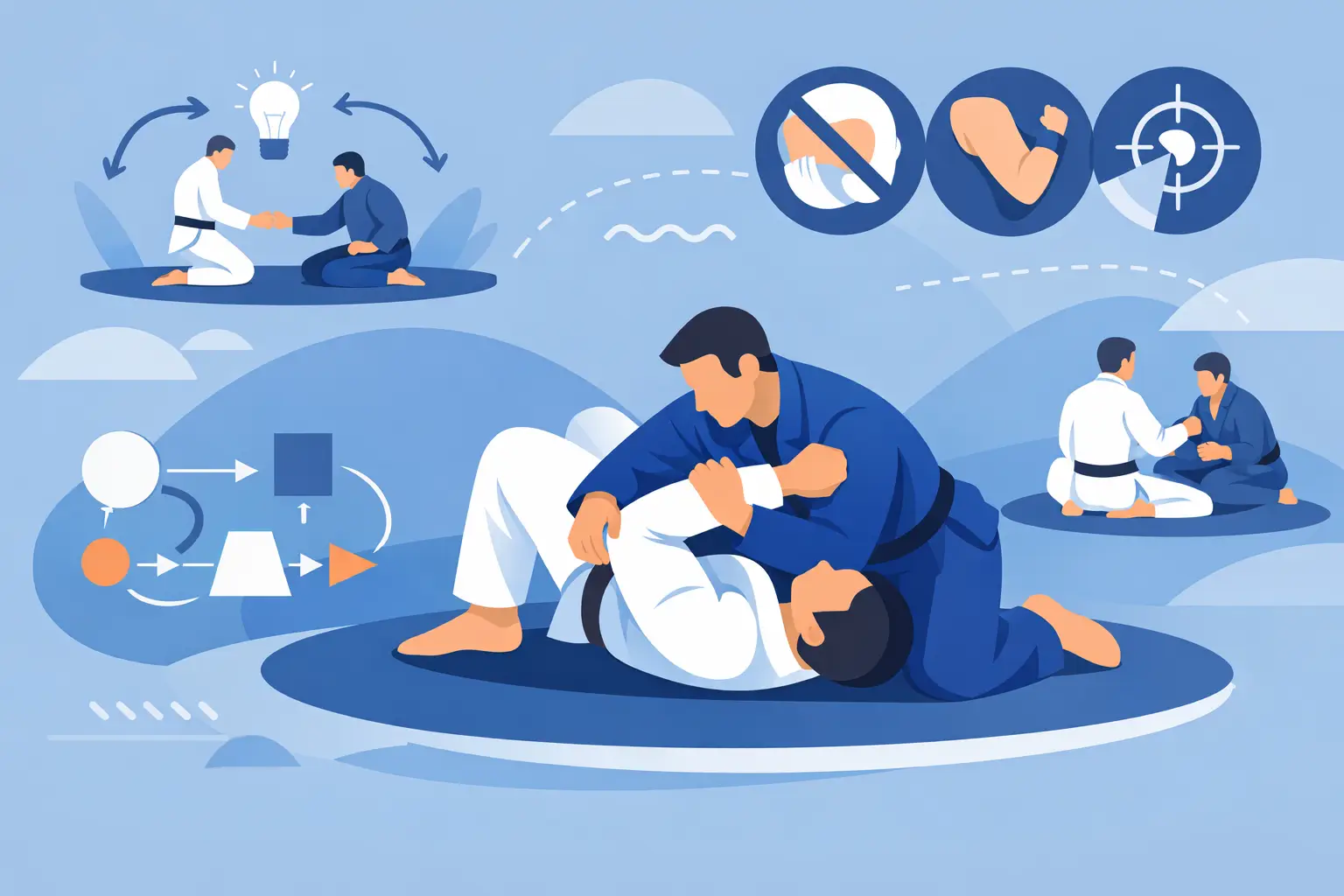
A useful constraint changes what the athlete notices, chooses, and solves under resistance. That is the practical starting point for how to teach BJJ constraints. The goal is not to make training artificially difficult or to hide techniques behind clever rules. The goal is to design an environment where the behavior you want becomes the most functional answer to a real grappling problem.
For BJJ instructors, this requires a shift in class design. Rather than beginning with a technique and asking students to reproduce its visible shape, begin with the tactical problem: retain guard against a passer who has cleared your knees, create an underhook from bottom half guard, or escape side control before the top player settles chest-to-chest. Then build a game that gives athletes meaningful information, live opposition, and enough boundaries to direct learning without prescribing every movement.
Start With the Problem, Not the Move
Constraints-led coaching works best when each game has a clear performance intention. Before selecting rules, ask what you actually want students to improve. “Better guard retention” is too broad for one round. “Recover inside position after the passer beats the feet” gives you a much more useful target.
A well-defined problem has three parts: a starting situation, a desired outcome, and a realistic source of resistance. For example, a guard retention game may start with the passer at headquarters or with the bottom player’s legs already displaced. The bottom player scores by recovering a meaningful guard connection, while the passer scores by reaching a stable passing position or chest-to-chest control.
This focus prevents a common coaching error: using a constraint because it looks creative rather than because it serves learning. If a rule does not sharpen the problem, reveal a useful decision, or increase representative resistance, it is probably noise.
Define what success looks like
Success should be observable by both coach and athlete. Avoid vague instructions such as “work your frames” or “be more active.” Instead, define outcomes athletes can recognize during the exchange: establish an elbow-knee connection, get to an underhook and come to the knees, clear the crossface, or force the opponent to post before standing.
Clear outcomes also make post-round coaching more precise. You are no longer evaluating whether a student performed your preferred technique. You are evaluating whether they solved the task, what information they used, and where the exchange broke down.
Build Constraints Around Affordances
In BJJ, athletes act on opportunities presented by posture, distance, grips, pressure, alignment, and momentum. These opportunities are often called affordances. Good constraints make relevant affordances easier to perceive without telling athletes exactly what to do.
If you want students to recognize when an underhook is available from half guard, do not simply tell them to pummel for one. Create a starting position where the top player has a realistic crossface and shoulder pressure, but cannot lock a settled body lock or progress until they flatten the bottom player. The bottom player now has a genuine reason to fight head position, frame, turn onto their side, and search for the underhook. The game teaches the relationship between those actions and the opponent’s pressure.
You can shape the task through three broad categories of constraints:
- Task constraints change the rules, scoring, starting position, time limit, or permitted targets.
- Environmental constraints change the space, such as using a wall boundary, a narrow lane, or a designated finishing area.
- Individual constraints account for athlete differences, including experience, size, mobility, injury history, and confidence.
The first category will do most of the work in a normal academy class. The other two are valuable when they improve realism or make the game safe and accessible. A narrow space can emphasize clinch control and wall awareness. A modified goal can allow a newer athlete to work a meaningful escape without asking them to survive a fully dominant version of the position for two minutes.
How to Teach BJJ Constraints Without Over-Controlling
The central trade-off is direction versus freedom. Too little structure produces vague sparring, where athletes return to their favorite habits and the intended problem disappears. Too much structure produces compliance, where they learn the rule instead of learning to grapple.
Start with the minimum effective constraint. If the goal is to improve standing guard passing entries, you may only need to require the passer to begin outside contact and score after controlling the hips long enough to enter a passing position. There is no need to ban every grip, dictate a sequence, or create five different scoring exceptions.
Run a short round and watch what the game actually produces. If athletes immediately disengage, the task may need a space boundary or a reset rule. If the bottom player stalls in a position that would not be viable in a real exchange, adjust the scoring so they must recover a functional guard rather than merely prevent the pass. If the same solution wins every time, consider whether the game is too narrow or whether students need exposure to the solution before you increase variability.
The constraint is not sacred. It is a coaching variable. Change it when the behavior it produces is no longer aligned with the objective.
Use rules that preserve the fight
A strong BJJ game still feels like grappling. Both athletes should have a reason to act, a credible path to success, and feedback from their opponent’s resistance. This is why symmetrical tasks can be useful, but asymmetrical games are often more targeted.
In an asymmetrical side-control escape game, the top player may score for stabilizing chest-to-chest control for three seconds, while the bottom player scores by reaching guard, turtle, or standing base. Each person has a distinct job, but neither is reduced to a compliant training partner. The top player learns to hold and transition under escape pressure. The bottom player learns to identify escape windows under real control.
Avoid rules that create obviously unrealistic behavior. Telling the top player they cannot use their hands may force movement, but it can also remove the very pressure and posting cues the bottom player must learn to read. Restricting a specific grip, on the other hand, may be useful if it exposes a neglected route without destroying the structure of the exchange.
Coach the Information, Not a Script
During a constraint-led round, coaches often talk too much. Constant technical correction can pull athletes away from the information available in the task and back toward performing for the instructor. Your role is to direct attention, ask useful questions, and intervene when safety or clarity requires it.
Instead of saying, “Put your right foot here,” ask, “What changed when their head moved outside your shoulder line?” Rather than telling a player to force a sweep, ask, “When did their weight become light enough to off-balance them?” These questions help athletes connect action to opponent behavior.
Use short coaching cues between rounds. One cue should be enough for the next repetition: protect inside space before chasing the underhook; make them post before you turn; win head position before you drive forward. The cue should focus attention, not become a sequence to memorize.
There are times when direct demonstration is appropriate. A brief demonstration can establish safety, clarify what a stable position looks like, or give beginners a starting reference when they have no workable solutions. The difference is intent. Demonstrate to expand an athlete’s options, then return them to a task where they must decide when and why to use those options.
Organize Progression Across a Session
A constraint-led class should not be a random collection of games. Build a progression that moves from a clearer version of the problem toward a more variable one.
For a class on escaping bottom side control, begin with a constrained task where the bottom player starts with a frame and the top player begins without a crossface. This gives students repeated exposure to the early escape battle. Next, allow the crossface but require the top player to maintain control before attacking. Finish with a broader positional round in which escapes, guard recovery, transitions, and submissions are all available.
The final game does not need to be fully open sparring every time. It should be broad enough to test transfer, but narrow enough that the day’s problem still appears frequently. That depends on the class level, the time available, and the purpose of the session.
Document the game after class. Record the objective, starting position, scoring, constraints, common athlete responses, safety notes, and the adjustment you would make next time. Over time, this becomes a coaching system rather than a collection of ideas. A platform such as ConstraintCoach can help instructors organize those games, session plans, and observations into a repeatable instructional workflow.
Measure Whether the Game Is Working
A game is working when it reliably produces the decisions you intended to train. It is not working simply because students are tired, engaged, or enjoying the round, although those outcomes matter.
Review what you observed. Did athletes encounter the target problem often enough? Did the scoring encourage functional behavior? Were newer students able to participate without freezing, while experienced students still had meaningful challenges? Did the final, less constrained round show any transfer?
Do not expect every athlete to find the same answer. BJJ is full of individual differences in reach, speed, flexibility, preferred guard systems, and competitive style. The standard is not uniform technique. The standard is improved adaptation to the problem.
The best constraint is often the one that lets you say less while athletes learn more. Build the task carefully, watch the behavior it creates, and make the next adjustment based on what happened on the mat.