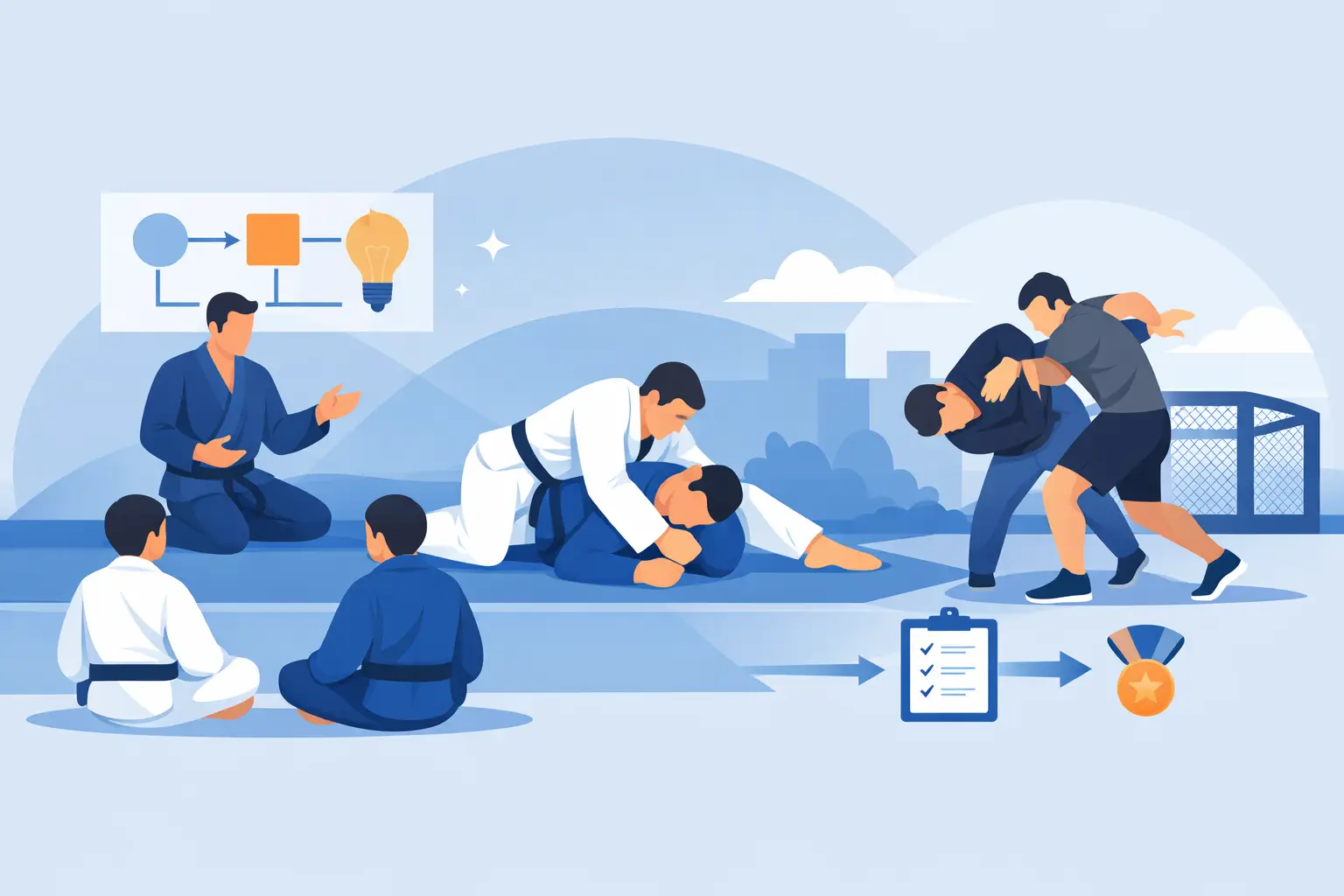
A good BJJ class should not depend on whether students can remember a sequence you demonstrated ten minutes earlier. When you build BJJ game based classes, the goal is to create practice environments where athletes repeatedly perceive relevant information, make decisions, and experience the consequences of those decisions under resistance.
That shift changes the coach's job. Rather than asking, “What technique should I teach tonight?” start with a more useful question: “What problem should athletes become better at solving?” A class built around that question is easier to organize, easier to coach, and more likely to produce behavior that appears during live rounds.
Start With a Single Performance Problem
Every effective game-based session needs a clear performance problem. This is not a broad position such as guard passing or back control. It is a specific task that gives the room a shared direction.
For example, a passing class might focus on helping top players clear and control the inside space between the defender's knees and elbows. A guard retention class might focus on recovering inside frames before the passer establishes chest-to-chest control. A front headlock class might focus on preventing the opponent from building height and reconnecting to the legs.
The narrower the problem, the easier it becomes to choose constraints that actually matter. If the session objective is too broad, the game becomes a generic sparring round with a different starting position. Athletes may still work hard, but the class lacks a reliable learning target.
Write the objective in observable language. Avoid phrases such as “understand passing pressure.” Instead, use language such as “top player can close distance without allowing the bottom player to establish stable inside hooks.” The second version tells you what to watch for and what success looks like.
Build BJJ Game Based Classes Around Representative Tasks
A game should preserve the important information and decisions of the live situation. This is the principle of representativeness. If athletes need to learn how to pass a seated guard, they need an opponent who can frame, grip, scoot, off-balance, and recover. Removing every defensive option may make the game cleaner, but it can also remove the very problem students must learn to solve.
That does not mean every game must begin as full sparring. It means the task should maintain a meaningful relationship to the real exchange. Start from a position that occurs in training or competition, give each athlete a legitimate objective, and allow actions that make the key problem visible.
Consider a seated guard passing game. The top player scores by getting past the knees and stabilizing chest-to-chest or securing a clear passing position. The bottom player scores by creating meaningful off-balances, entering a leg attack, coming up to a single, or recovering a strong guard connection. Both athletes have reasons to act. Neither is reduced to being a compliant training partner.
A useful test is simple: if you removed the coach from the room, would the rules still direct athletes toward the behavior you want? If the answer is no, the game may rely too heavily on explanation rather than task design.
Use Constraints With a Clear Purpose
Constraints are not arbitrary restrictions designed to make practice difficult. They are design choices that shape attention and behavior. The best constraints help athletes find solutions to the stated performance problem without prescribing one exact technique.
A constraint can change the environment, the task, or the athlete's available actions. For instance, a passer may begin with one knee already inside the guard, reducing the distance problem and emphasizing pressure and connection. A bottom player may earn a point only after establishing an underhook and coming to an elbow, directing attention toward a specific escape pathway. A wall can be used to change the affordances of wrestling up from guard.
Use fewer constraints than you think you need. When a game has too many rules, students spend their time remembering rules instead of reading their opponent. One scoring condition and one or two meaningful boundaries are often enough.
The trade-off is that simpler games can expose more variation, including solutions you did not expect. That is not a flaw. It is often evidence that athletes are adapting to the task. Your role is to determine whether those solutions serve the learning objective, create a safety issue, or reveal that the game needs adjustment.
Design Progressions by Changing the Problem
A progression should not merely add rounds or increase intensity. It should change the difficulty of the performance problem while preserving the session's central theme.
A practical three-stage progression often works well. Begin with a constrained entry point that gives athletes immediate contact with the key problem. Then expand the opponent's options so they must recognize more information. Finish with a more open round where the target behavior must survive against realistic resistance and transitions.
For a class on escaping side control, the first game may start with the bottom player already holding a near-side frame and needing to recover guard or come to the knees. The next game allows the top player to switch between chest-to-chest pressure, north-south, and head-and-arm control. The final round begins from a common entry, such as a failed underhook from half guard, and continues until a clear escape, submission, or stable control is achieved.
Do not treat open sparring as the only measure of transfer. Short, targeted rounds can show transfer more clearly because the athletes encounter the problem many times. A six-minute open roll may contain one side-control escape. Four two-minute targeted rounds may create ten or more meaningful attempts.
Coach the Information, Not the Move
Game-based coaching is active, but it is not constant technical narration. Over-coaching can turn an adaptive task back into a memorization exercise. Instead of supplying every answer, direct attention toward the information that helps athletes choose better actions.
During a passing game, you might ask, “What happens to their knees when your head gets below their shoulder line?” During guard retention, ask, “Which frame disappeared before they controlled your chest?” These questions help athletes connect outcomes to cues in the exchange.
Use brief stoppages when the whole group is missing the same problem or when safety requires an immediate reset. Otherwise, let the round produce evidence. Watch for common patterns: where athletes stall, which rule they exploit, what positions create confusion, and whether the scoring system rewards the intended behavior.
Your feedback should also match the athlete's level. Beginners may need simpler task boundaries and clearer definitions of stable control. Advanced students usually benefit from more freedom, more realistic counters, and questions that force them to explain their choices. The objective can remain the same while the game design changes.
Make Scoring and Resets Operational
Poor scoring is one of the fastest ways to weaken a class. If athletes cannot identify who won an exchange, the game becomes vague. If points are awarded for actions that are easy to fake, students will optimize for the scoreboard rather than the learning goal.
Define success with visible outcomes. “Pass the guard” needs a standard, such as clearing both legs and holding a dominant control for three seconds. “Escape side control” needs a standard, such as recovering guard, reaching the knees with control, or creating enough separation to stand safely. Clear resets keep the pace high and prevent long dead zones.
Also decide what happens after a score. Immediate reset works when you want many repetitions of a clean problem. Continuation works when the next phase is part of the skill, such as passing into control or escaping into a wrestle-up. The right choice depends on the behavior you are trying to develop.
Capture What the Class Teaches You
A repeatable coaching system needs more than good ideas. It needs records. After class, log the objective, game rules, athlete level, time spent, common failure points, and any adjustment you would make next time. Over several weeks, those notes become a real curriculum asset rather than a collection of isolated sessions.
This is where a structured platform such as ConstraintCoach can support the work. A searchable game library, session plans, and coaching logs make it easier to reuse effective designs while preserving the context that made them work.
Do not judge a game only by whether athletes enjoyed it. Engagement matters, but the stronger question is whether the game consistently created the decisions your athletes need in live jiu-jitsu. Build the next class from that evidence, and your curriculum will become more precise with every session.