A coach stops the room after a chaotic round of seated guard. One student keeps reaching for a collar tie that exposes their posture. Another is winning the inside space but cannot convert it into an angle. The fastest response may be to line everyone up and demonstrate the preferred sequence. The more useful response may be a question, a rule change, or a reset that makes the relevant information easier to perceive.
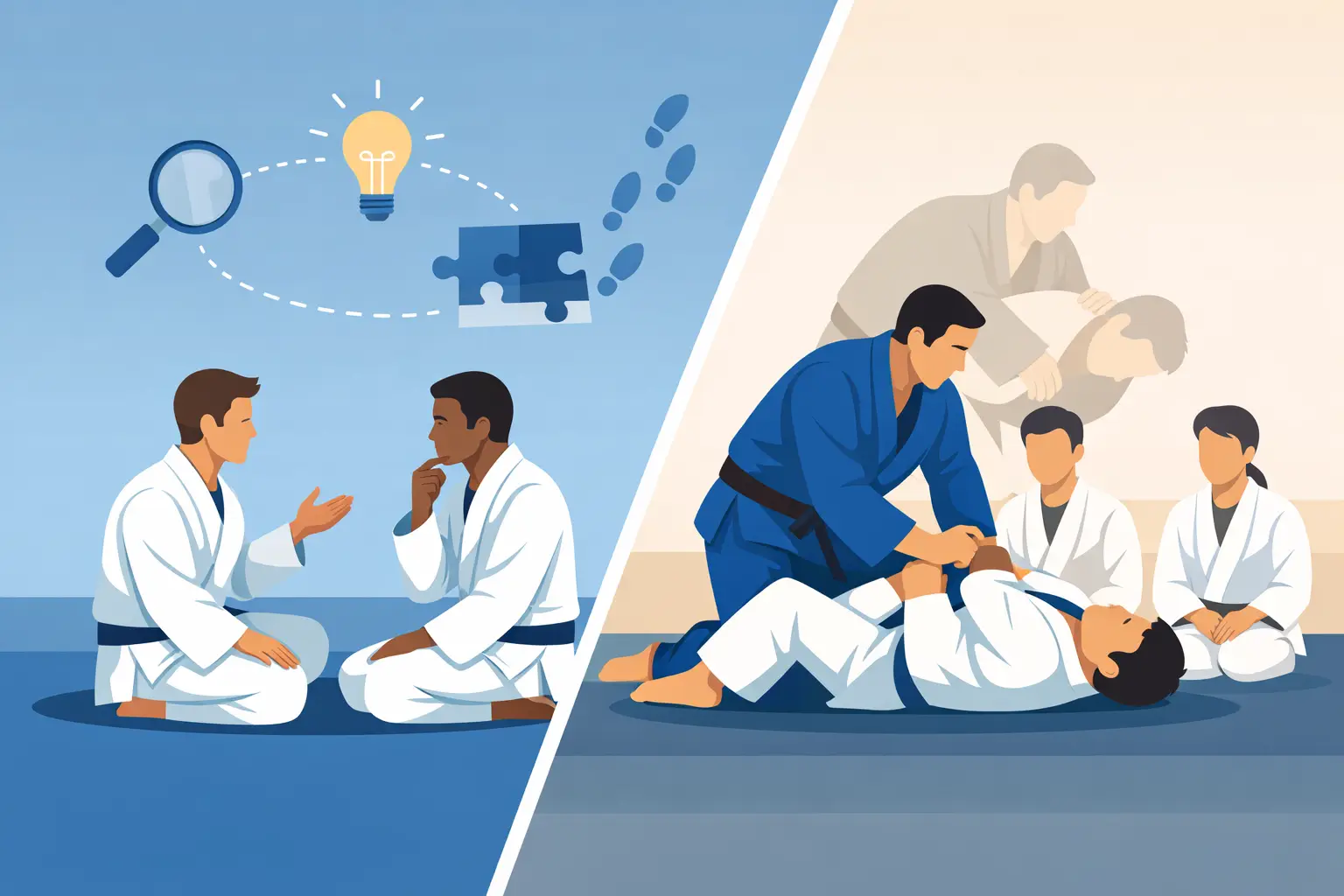
That is the practical tension in guided discovery versus BJJ demonstrations. This is not a choice between being a modern coach who never shows technique and a traditional coach who explains every detail. It is a question of how athletes learn to identify problems, select actions, and adapt under resistance. For BJJ instructors building a constraints-led curriculum, the distinction has direct consequences for class design, athlete engagement, and skill transfer.
What Each Method Actually Does
A demonstration gives athletes a reference point. It can show the shape of a position, establish safety expectations, introduce unfamiliar equipment or rules, and make a task immediately intelligible. A concise demonstration is especially valuable when students have no workable picture of the problem they are trying to solve.
Guided discovery asks athletes to find functional solutions through representative practice. The coach designs a game with a clear objective, relevant resistance, and constraints that direct attention toward useful information. Rather than supplying the answer in advance, the coach helps students notice what is happening and adjust their behavior.
The difference is not simply verbal instruction versus silence. Good guided discovery is active coaching. The coach observes, changes task constraints, asks targeted questions, and decides when a brief intervention is necessary. Poor guided discovery, by contrast, is often just under-coached sparring with vague instructions.
Likewise, a demonstration is not automatically outdated. The problem begins when the demonstration becomes the entire lesson: show a sequence, ask students to reproduce it cooperatively, then assume the sequence will appear under live resistance. BJJ is a reciprocal, changing environment. Athletes need more than a visual model. They need repeated opportunities to perceive timing, pressure, space, connection, and threat while making their own decisions.
Guided Discovery Versus BJJ Demonstrations in Real Classes
The useful comparison is not which method is superior in every setting. It is which coaching input best serves the current learning problem.
If a beginner does not understand what a crossface is meant to accomplish, a 30-second demonstration can establish the objective: control head position, reduce turning space, and create a stable pathway to passing. The class can then enter a game in which the top player scores by holding chest-to-chest control for a defined period while the bottom player scores by getting to an elbow or recovering guard. The demonstration gives orientation. The game develops the skill.
If an intermediate student already understands the objective but keeps forcing a knee cut into poor alignment, another full demonstration may not solve the issue. Their problem may be perceptual. They may fail to recognize when the bottom player has inside frames, when their hip is too far away, or when the underhook battle has been lost. A constraint-led task can make those conditions impossible to ignore. For example, require the passer to establish a head-and-arm control before scoring, or allow the bottom player an immediate point for turning to their side before the pass is stabilized.
In both cases, the coach is still teaching. The difference is whether information is delivered as a prescribed answer or encountered through the task.
Demonstrations are strongest when they create clarity
Use demonstrations when the class needs a fast shared reference. This often includes safety-critical mechanics, unfamiliar positional rules, the start and stop conditions of a game, or a basic orientation to a new area of the sport.
They also help when your language needs to be anchored to something athletes can see. If you ask students to "keep your head higher than theirs" during a front headlock game, show them the general relationship you mean. Do not turn that into a four-minute lecture on every possible finish.
The key is restraint. Demonstrate the objective, the relevant boundaries, and perhaps one or two examples of functional behavior. Then let athletes test the idea against a resisting partner. The more you demonstrate every branch of the decision tree, the more likely athletes are to search for your pattern instead of reading their opponent.
Guided discovery is strongest when decisions matter
Guided discovery is most useful when multiple solutions can work and the athlete must adapt to an opponent's behavior. This describes much of effective BJJ.
A guard retention problem is not solved by memorizing a single hip escape. The player must recognize distance, frame quality, leg position, passing direction, and the opponent's timing. A well-designed game preserves these information sources while reducing unnecessary complexity. The athlete can then explore, fail, recalibrate, and improve within a task that still resembles the competitive problem.
This is why constraints matter more than clever questions alone. Asking, "What could you do differently?" may prompt reflection, but it does not automatically change the environment. A scoring rule, starting position, space limitation, time constraint, or partner role can alter what actions become viable and what information the athlete must attend to.
The Cost of Overusing Either Approach
Coaches who rely too heavily on demonstrations often create compliant students. Athletes can look sharp during cooperative repetitions because the partner gives them the expected reaction and the sequence has already been selected. Under pressure, the same athlete may freeze when posture, grips, or timing change. They have practiced the movement but not necessarily the decision.
Coaches who avoid demonstrations on principle can create a different problem: ambiguity. Newer students may not know the objective, may misunderstand the rules, or may repeatedly rehearse unsafe habits. Advanced students can also waste rounds if the task does not make the target behavior clear enough.
The trade-off is instructional precision. Demonstrations offer efficient clarity but can narrow exploration. Guided discovery develops adaptable behavior but requires better task design, closer observation, and a willingness to intervene without taking over.
The answer depends on athlete experience, the risk level of the position, the complexity of the task, and the specific behavior you want to improve. A beginner learning to apply a safe rear naked choke needs more initial direction than an experienced purple belt learning to retain guard against a body-lock pass.
A Better Operating Model for Coaches
Instead of planning classes around a technique of the day, plan around a performance problem. Define the position, the athlete's objective, the opponent's objective, and the information that should guide action. Then decide what athletes need before they can productively play.
A reliable session may begin with a brief demonstration of the game and its central objective. From there, give athletes a constrained round that creates frequent repetitions of the target problem. Observe for patterns, not isolated mistakes. If many students are missing the same opportunity, use a short intervention: demonstrate a relationship, adjust the rules, or ask a question that directs attention to a relevant cue.
For example, in a mount escape session, the initial game might reward the bottom player for getting to an elbow and knee connection while rewarding the top player for maintaining chest alignment. If students repeatedly bench press and expose their arms, do not immediately teach a long escape series. Pause, show the difference between pushing the opponent away and creating a frame that protects elbow position, then restart the game. The game supplies the context. The demonstration sharpens the search.
This structure also gives assistant coaches a clearer role. Rather than each coach offering a different technical correction, they can watch for defined behaviors: elbow recovery, head position, inside space, hip alignment, or successful escapes after a frame is established. That creates more consistent feedback across the room.
Build Demonstrations Into the System, Not the Center of It
For a coaching staff, the practical challenge is repeatability. A game should not depend on one coach remembering the perfect explanation on a busy night. Document the objective, start position, scoring conditions, safety notes, likely athlete errors, and the short demonstrations that may be useful.
ConstraintCoach supports this kind of workflow by helping coaches organize games, lesson plans, and session notes in one system. The goal is not to standardize every sentence a coach says. It is to standardize the training problem, the constraints, and the observation points so the class remains coherent across different instructors and sessions.
Over time, session logs become valuable evidence. Did the space restriction create better off-balancing, or only more stalling? Did a demonstration improve safety without reducing exploration? Were newer athletes able to enter the game, or did they need a simpler starting condition? These are curriculum decisions, not just personal coaching preferences.
Coach the Search, Then Clarify What Matters
The strongest BJJ classes do not treat discovery and demonstration as competing ideologies. They use demonstrations to establish orientation and safety, then use representative games to make athletes earn the timing, judgment, and adaptability that techniques alone cannot provide.
When you feel the urge to show the answer, first ask what athletes are failing to perceive. If a short demonstration will make the task clearer, use it. If the task itself is hiding the lesson, redesign the constraint. Your athletes do not need less coaching. They need coaching that helps them see, decide, and act when the opponent refuses to cooperate.