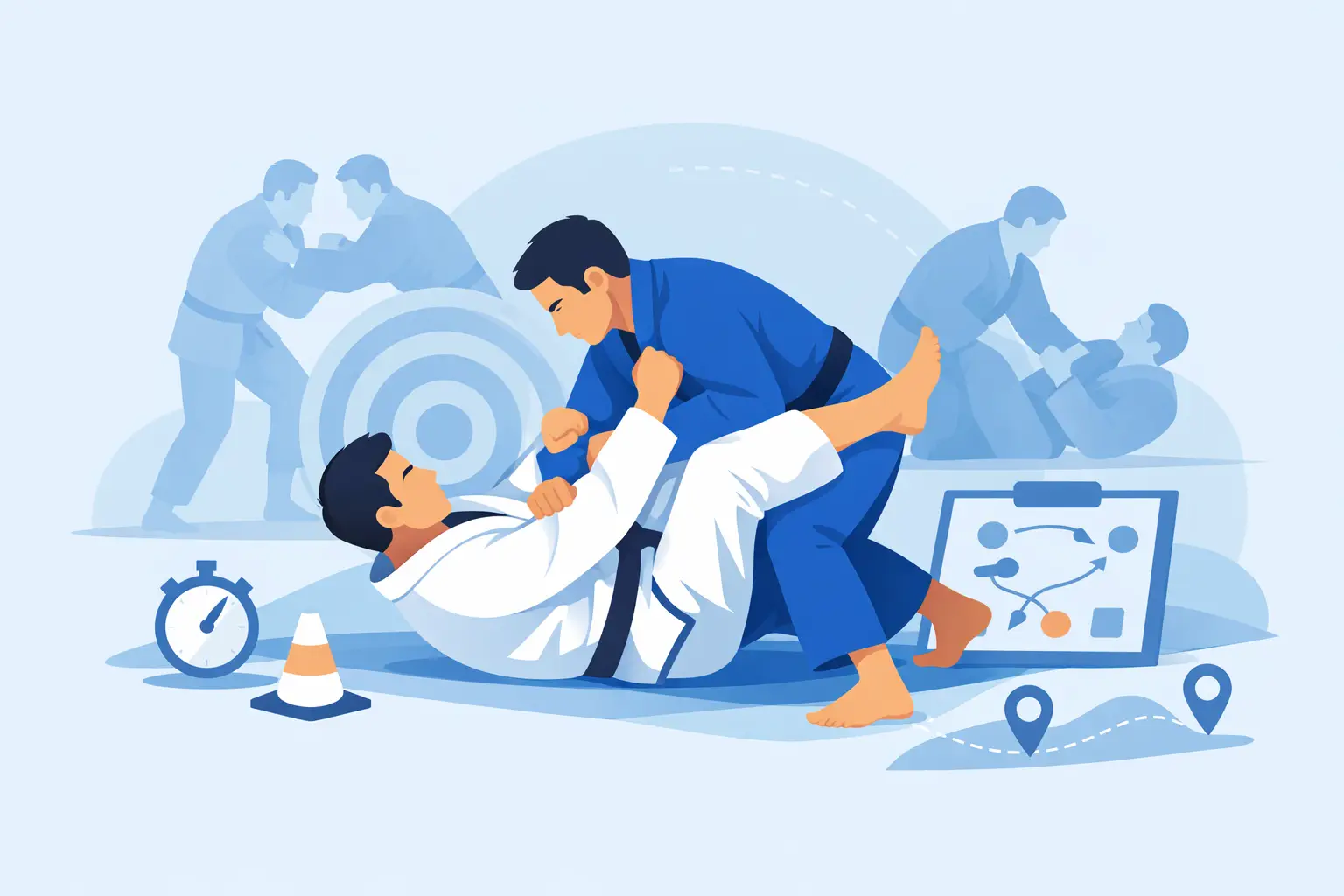
A task can look like jiu-jitsu and still teach athletes to make decisions that disappear the moment a round starts. That is the central problem when coaches design representative BJJ practice tasks. The goal is not to reproduce every detail of a competition match. It is to preserve the information, pressures, choices, and consequences that make the targeted action necessary in live grappling.
For an instructor, representativeness is a practical design standard. It asks a simple question: when athletes succeed in this game, are they solving the same type of problem they will face in sparring? If the answer is no, the task may create activity without creating useful adaptation.
What Makes a BJJ Task Representative?
A representative practice task keeps the athlete connected to the opponent and the environment. The opponent is not a compliant prop. They have an objective, can adapt, and create the timing problems that make grappling difficult. The athlete must perceive a cue, select an action, and adjust when the first answer fails.
Consider a coach who wants to improve standing guard retention. A common isolated exercise might ask one athlete to place a foot on the hip, frame, and recover to an open guard position while the partner offers minimal resistance. That may help an athlete become familiar with body positions, especially at the earliest stage of learning. But it removes the key problem: the passer’s changing angle, grips, pressure, and intent to get around the legs.
A more representative task gives the passer a meaningful scoring objective, such as clearing the knees and establishing chest-to-chest control for three seconds. The guard player scores by retaining inside position, recovering a recognized guard, or standing safely. Now the guard player must read direction, manage distance, and choose between framing, pummeling, hip movement, and standing. The form is no longer the lesson. The interaction is.
Representativeness does not mean uncontrolled sparring. A task can be narrow, heavily constrained, and still realistic in the information it provides. In fact, well-designed constraints often make the relevant problem clearer than a full round does.
Start With the Competitive Problem, Not the Technique
The most reliable task design process begins with a problem athletes need to solve under pressure. Avoid beginning with a named technique and then searching for a game that permits it. That approach often leads to a disguised drill where athletes are rewarded for repeating the coach’s preferred answer.
Instead, define the situation in functional terms. For example: the bottom athlete is losing upper-body alignment in half guard and needs to prevent the crossface, create connection, or recover a stronger guard. This framing gives the coach room to build a task around the actual conflict rather than around one sequence.
A useful planning statement includes four elements: the starting relation, each athlete’s objective, the boundary of the exchange, and the condition that ends the rep. For example:
“Start in knee shield half guard with the top athlete holding a crossface or working toward it. The bottom athlete scores by recovering inside head position, getting to an underhook-based wrestle-up, or recovering full guard. The top athlete scores by flattening the bottom athlete and passing to side control. Reset when a score occurs or after 30 seconds.”
That is specific enough to run consistently, yet open enough for athletes to find different solutions. A newer athlete may focus on elbow position and hip distance. An advanced athlete may connect the same problem to arm drags, leg entries, or back exposure. The shared task keeps the class coherent without forcing identical movement.
Preserve the Cues That Trigger Action
Every technique is normally triggered by information. A guard player reacts to a passer’s head position, a change in hip height, an inside tie, or a hand reaching across the centerline. Remove those cues, and athletes may learn choreography rather than timing.
When setting the start position, include the cue whenever possible. If the lesson concerns defending a body lock pass, do not always begin after the passer has been frozen in a perfectly symmetric body lock. Allow the passer to work toward connection from a realistic distance. If the defensive athlete only practices after the problem is fully formed, they lose the opportunity to recognize and act on the earlier signal.
This is also why static “one-for-one” repetitions have limited transfer. They can support orientation, confidence, or safety, but they do not require perception. Coaches should use them deliberately, not mistake them for the main learning environment.
Use Constraints to Shape Behavior, Not Script It
Constraints are the rules, scoring conditions, spatial limits, time limits, and starting positions that guide athlete behavior. Good constraints direct attention toward a problem. Poor constraints dictate a solution.
If you want athletes to improve front headlock attacks, a rule stating “you may only finish with a guillotine” is highly restrictive. It may produce guillotine attempts, but it also teaches athletes to ignore openings for go-behinds, back takes, anacondas, and snap-downs that are available in the same exchange.
A better constraint might reward the attacking athlete for holding the opponent’s head below their hips for three seconds, taking the back, or completing any submission. The defender scores by clearing the head, standing to neutral, or completing a reversal. The task directs athletes toward the central control problem while preserving decision-making.
Constraints should match the outcome you actually want. If the objective is to develop movement quality under fatigue, short rounds with rapid resets may be useful. If the objective is to develop sustained pressure passing, longer rounds may better expose pacing, grip management, and positional patience. Neither format is universally better. The design depends on the behavior being developed.
Build Tasks With Clear Affordances and Honest Resistance
Athletes need available actions that make sense from the situation. In ecological dynamics terms, these are affordances: opportunities for action perceived in relation to the athlete, opponent, and environment. Coaches do not need academic language to use the idea well. They simply need to ask whether the task presents real options.
A task with only one plausible move often becomes a drill with extra motion. A task with unlimited options may become too broad for the class objective. The productive middle ground gives athletes a small set of relevant opportunities and lets the opponent make those opportunities unstable.
Honest resistance matters here. The defender should be trying to solve their own problem, not merely offering progressively harder resistance on command. If the bottom athlete is supposed to escape mount, the top athlete needs a legitimate reason to maintain mount and pursue progression. If the top athlete is only instructed to “give 60 percent,” athletes often receive inconsistent pressure and unclear feedback.
Scoring solves much of this. Define what both people are trying to achieve, then let their resistance emerge from the game. This produces more reliable intensity than vague instructions to be cooperative but realistic.
Scale Difficulty Without Removing the Problem
When a task fails, coaches often make it easier by removing opposition or reducing the exchange to a static pattern. That can be appropriate for a first exposure, but it is not the only way to scale difficulty.
Keep the problem intact and adjust one variable. Give the athlete a stronger starting position. Narrow the opponent’s available attacks. Increase the size of the target area. Extend the time needed to secure control. Pair athletes strategically. These changes preserve the relationship between action and consequence.
For a guard retention task, a beginner may start with both feet already inside and the passer limited to one side of the body. A more experienced athlete may start with one leg partially beaten and allow the passer full directional freedom. Both athletes are still reading a passer and solving a retention problem. The task changes in degree, not in identity.
This principle is especially useful in mixed-level classes. Rather than running separate lessons for every rank, maintain the same game structure and modify entry conditions or scoring thresholds. It improves class flow and gives assistants a clear way to support athletes without inventing separate content on the spot.
Test the Task During Class
No task is complete when it is written in a lesson plan. The class is the test environment. Watch what athletes repeatedly do, what they avoid, and where rounds stall.
If every athlete reaches the same outcome through a loophole, the scoring may be misaligned. If no one can score, the entry position may be too difficult or the time window too short. If one athlete has no reason to engage, the opponent’s objective may lack value. These are design signals, not athlete failures.
Use brief coaching interventions between rounds. Ask athletes what they were seeing before they lost position. Ask what action felt available but disappeared under pressure. Then change one variable and run the game again. Avoid changing three rules at once, because you will not know which adjustment produced the result.
A session log turns this process into a coaching system. Record the task, athlete level, round length, scoring conditions, common outcomes, and your next adjustment. Over time, your library becomes more than a collection of games. It becomes evidence of how your room learns. ConstraintCoach is built around this kind of organized workflow, helping instructors connect game design, planning, delivery, and review instead of relying on memory alone.
Design Representative BJJ Practice Tasks for Transfer
Transfer is not guaranteed because a task is competitive, exhausting, or entertaining. It improves when the game repeatedly exposes athletes to the same meaningful decisions they face in live grappling. That includes the opponent’s intent, the relevant spatial relationship, the timing pressure, and a consequence that matters.
Before class, review each task with a direct question: what information must the athlete perceive to succeed? If the answer is unclear, the task likely needs refinement. If the answer is a live, recognizable cue from the position you are teaching, you have a useful foundation.
The strongest practice tasks do not tell athletes what jiu-jitsu should look like. They place athletes in a well-defined problem and give them enough reality to discover how their jiu-jitsu needs to work.