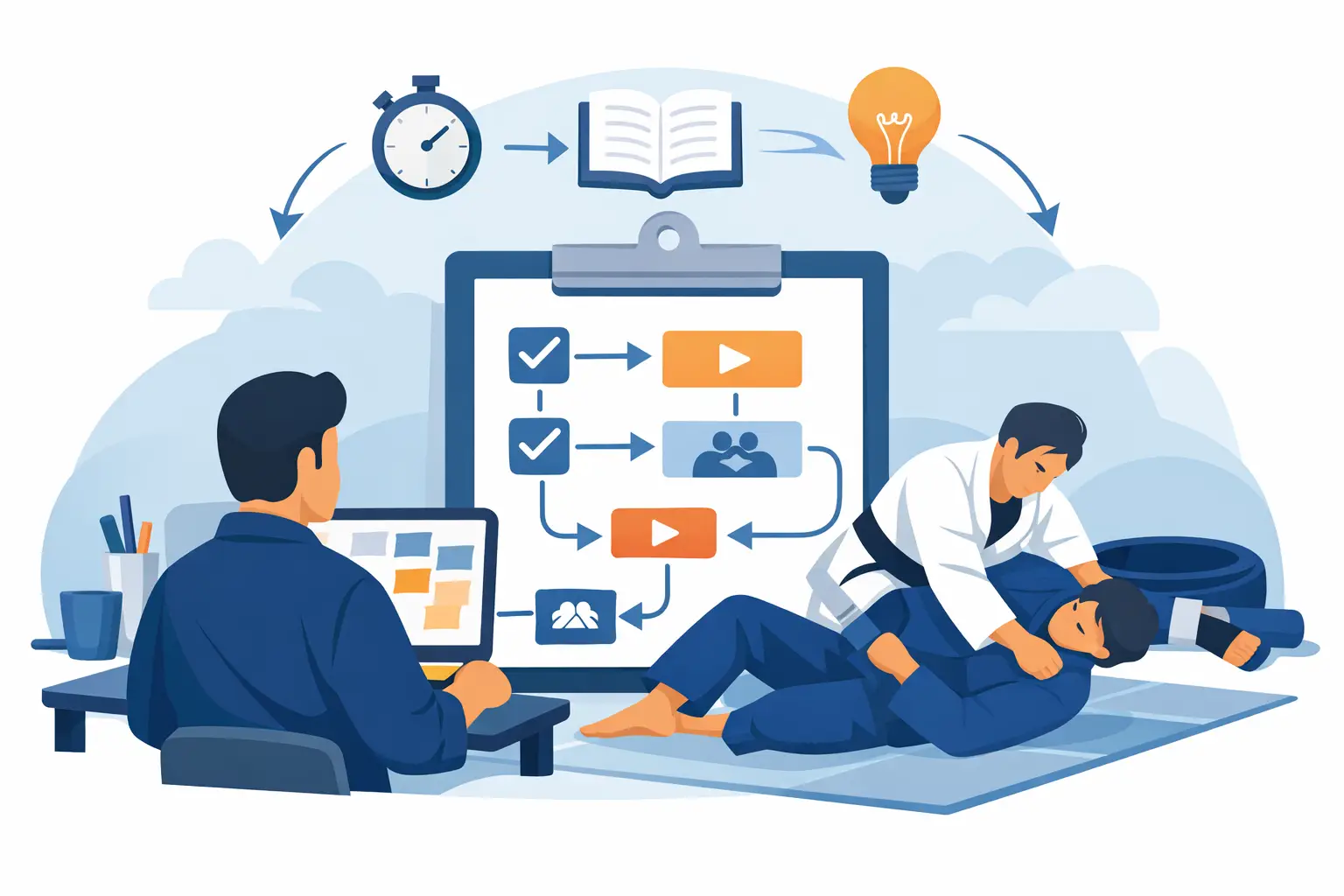
A good class can survive a rough plan. A coaching system cannot. When you create a BJJ lesson plan workflow, the goal is not to make every session look perfectly scripted. The goal is to give your coaching decisions a repeatable structure: what athletes are trying to solve, what conditions shape the solution, what you will observe, and what gets adjusted next time.
For constraints-led coaching, that structure matters even more. Games can look simple on the mat, but their design carries real instructional weight. A poorly chosen scoring rule can produce the wrong behavior. An unclear starting position can create long periods of inactivity. A game that is too open too early can hide the very problem you intended athletes to explore.
A workflow prevents those issues from becoming random weekly frustration. It turns planning from an isolated creative task into an operating system for your academy.
Start With a Training Problem, Not a Technique
Most lesson plans begin with a named technique: armbar, knee-cut pass, single-leg finish. That can be useful as a filing label, but it is a weak starting point for designing learning. It encourages coaches to decide the answer before athletes have encountered the problem.
Start instead with a representative problem. For example: how does the bottom player recover inside position when the passer is controlling the hips? How does the passer clear a knee shield without exposing their back to underhooks? How does a front headlock player keep connection when the opponent builds toward a single leg?
This framing does three practical things. It identifies the environment athletes need to experience, helps you choose a relevant starting position, and makes it easier to recognize meaningful progress. You are not asking whether everyone copied the same movement. You are watching whether they became more capable of solving the situation.
Write the problem in one sentence. If it takes a paragraph to explain, the class objective is probably trying to cover too much.
Define the athlete and the class context
The same game is not automatically appropriate for every room. A fundamentals class may need shorter rounds, simpler scoring, and tighter starting positions. An advanced competition group can often work with more freedom and a higher information load. A mixed-level evening class may need constraints that keep beginners involved without making experienced athletes bored.
Your workflow should capture the variables that change planning decisions: athlete experience, class length, attendance patterns, space, equipment, and current curriculum emphasis. This is not administrative clutter. It is the context that tells you whether a planned task is teachable tonight.
Build the Session Around One Core Game
A common planning mistake is trying to fit three unrelated positions, multiple techniques, and several games into one hour. Athletes may stay busy, but the learning signal becomes scattered. A stronger session usually has one central game that receives the most time and attention.
The core game should place athletes in a recognizable BJJ situation with enough pressure to make decisions matter. It needs a clear objective for both players, a starting condition that creates the intended problem, and rules that direct attention without dictating a sequence.
Consider a session focused on passing against knee shield. The top player may score by establishing chest-to-chest control past the legs or by reaching a stable pin. The bottom player may score by recovering a stronger guard, getting to a leg entanglement, standing up, or creating a reversal. Starting with the knee shield already in place keeps the task representative while reducing dead time.
The constraint is where coaching precision shows up. If the top player repeatedly backs away and resets, require them to maintain a connection to the lower body. If the bottom player is merely stalling, give them a meaningful escape or offensive score. If athletes are forcing the same answer regardless of what the opponent does, adjust the task so the opponent has a credible counter-problem.
A game should create possibilities, not a concealed drilling sequence.
Use progressions to change information, not just intensity
Progression does not always mean adding more moves or making a round harder. Often it means changing the information athletes must perceive.
You might begin with a fixed starting position where both athletes know the problem. Next, allow the bottom player to choose between two guard configurations. Later, begin from a short live exchange where the passer must recognize when the knee shield appears. The underlying theme remains consistent, but perception, timing, and decision-making become more demanding.
This is why a workflow should map a session as an arc rather than a stack of activities. A useful structure may include an arrival game, the core game, a variation that changes one condition, and a more open application game. Not every class needs all four. A 45-minute class may be better served by two well-run tasks than four rushed ones.
Create a BJJ Lesson Plan Workflow With Reusable Fields
Consistency does not require every class to feel the same. It requires a consistent way to capture why each class was built. Use the same planning fields for every session so that reviewing a lesson takes minutes rather than reconstructing your thought process from memory.
A practical lesson plan record should include the training problem, athlete group, primary game, starting position, objectives for each player, scoring conditions, key constraints, round format, and planned variations. Add a short coaching focus section: what behaviors will you observe, and what questions or external cues might you use?
Avoid filling this section with lengthy technical notes. If a coach needs a page of instructions to run the game, the design may be too complicated. The plan should make delivery easier under real class conditions, including late arrivals, uneven pairings, and athletes who need a quick reset.
It also helps to distinguish between non-negotiables and adjustable elements. The representative problem and player objectives are usually non-negotiable. Round length, space size, starting distance, and certain scoring rules can be adjusted on the floor. That distinction keeps you from abandoning the session's purpose simply because one detail needs to change.
Plan the Coaching, Not Only the Activity
A well-designed game does not eliminate coaching. It changes what the coach is responsible for noticing.
Before class, identify two or three observable behaviors connected to the training problem. In the knee-shield example, you might watch whether the passer controls the near hip before attempting to clear the leg, whether the bottom player builds frames before creating distance, and whether either athlete recognizes the value of inside position.
These observations give you a filter. Without one, coaching often drifts toward commenting on the most visible error or the technique the coach personally prefers. With one, feedback stays connected to the task.
Questions can be particularly useful when athletes are stuck. Ask what they felt when they lost connection, which frame created time, or what changed when they moved their hips before their upper body. The point is not to force a verbal answer from every student. It is to direct attention toward information that improves the next attempt.
There is a trade-off here. Too much interruption reduces repetition and can make games feel like lectures with brief rounds attached. Too little intervention can allow poor task understanding to persist. Plan a few likely interventions, then coach according to what the room actually shows you.
Log What Happened While It Is Still Useful
The lesson plan is only half the workflow. The session log is what makes the next plan better.
Immediately after class, record what was different from the original design. Did the scoring produce the behavior you wanted? Did one group need a tighter starting position? Did athletes find an unanticipated but productive solution? Did the game create a safety concern, confusion, or a major mismatch between skill levels?
Keep this log short enough that you will actually use it. A few specific notes are more valuable than a vague paragraph saying the class went well. For example: “Beginners stalled from knee shield when no stand-up score was available” is actionable. “Good energy” is not.
Over time, these notes become a coaching database. You can see which games work for different populations, which constraints need refinement, and where your curriculum has gaps. ConstraintCoach is built around this operational need: planning assets, game organization, and session records should support each other rather than live in separate documents and memory.
Organize Your Library So Planning Gets Faster
A game library becomes valuable when it is easy to retrieve by the question you are trying to answer. Organizing only by technique names is limiting because the same game may develop multiple skills: posture recovery, inside position, connection, off-balancing, or transition recognition.
Tag games by position, player role, training problem, intensity level, athlete level, and key constraints. You may also want tags for class format, such as small-space friendly, partner rotation friendly, or competition group. The right categories depend on your academy, but the purpose is consistent: reduce the time between identifying a need and selecting a usable task.
Do not overbuild the taxonomy at the start. If your system has 40 tags that nobody applies consistently, it creates more work than value. Begin with the categories you genuinely use when planning, then refine them as your library grows.
A dependable workflow gives you room to coach the class in front of you instead of trying to remember the class you planned last week. Build the plan clearly, observe it honestly, and let the next session be informed by what athletes actually did on the mat.