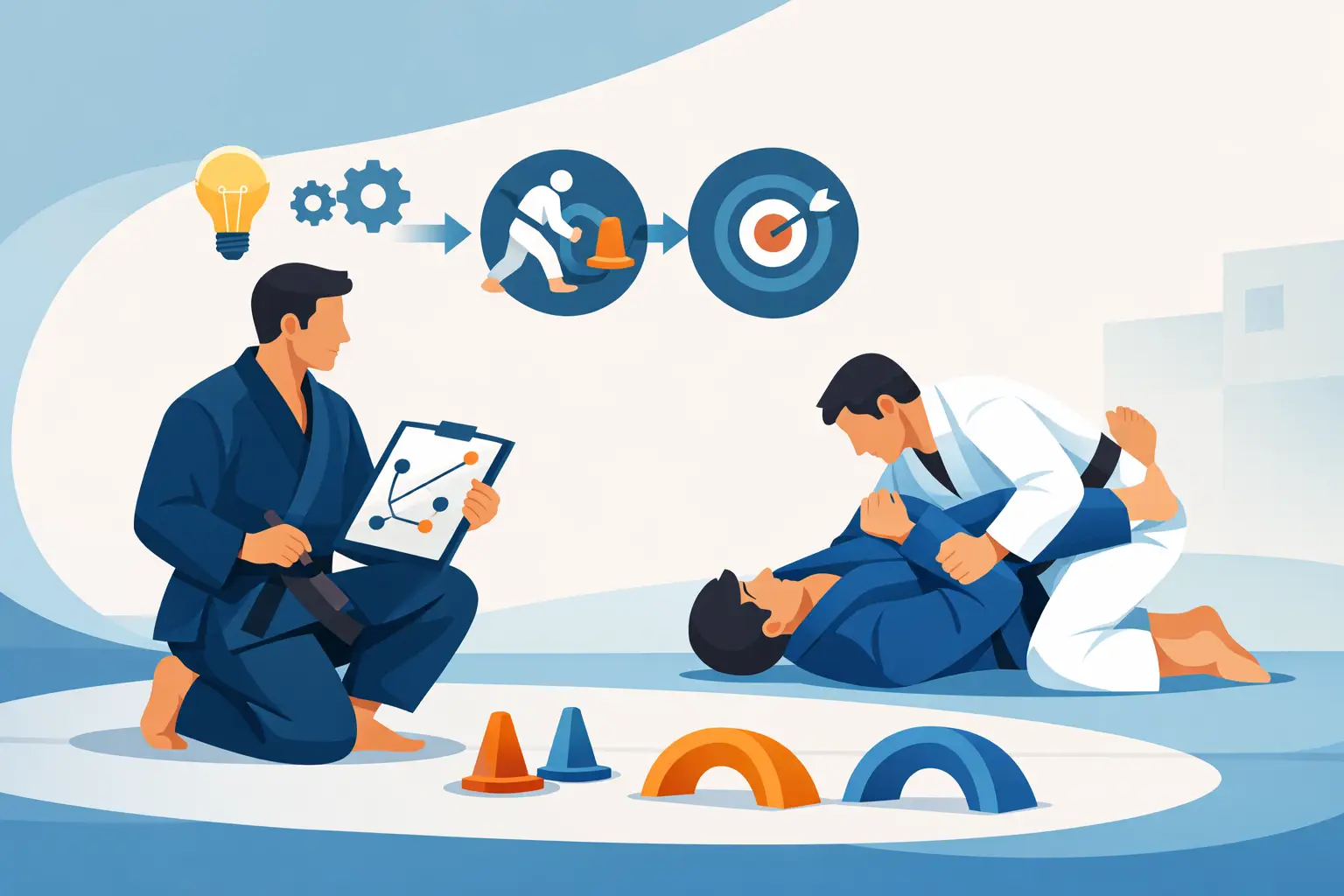
If your class still looks sharp on cooperative reps but falls apart once live resistance starts, the issue is usually not effort. It is task design. The constraints led approach BJJ coaches are adopting starts from that reality: athletes do not learn better decisions by rehearsing perfect shapes in low-information environments. They improve by solving real problems under well-designed constraints.
For instructors, that shift is bigger than swapping a few drills for games. It changes how you think about teaching itself. Instead of asking, "How do I show this technique clearly?" the better question becomes, "What environment will lead athletes to find and repeat the behavior I want?" That is a meaningful difference, especially if you are trying to build classes that transfer to sparring and stay consistent across coaches.
What the constraints led approach BJJ actually means
At a practical level, the constraints-led approach uses task, environmental, and individual constraints to guide learning. In jiu-jitsu, that means shaping rounds so the athlete has to perceive relevant cues, make decisions, and act under realistic pressure. The coach is not absent. The coach is designing the conditions that make useful actions more likely.
A simple example is bottom side control retention. You can explain elbow-knee connection, framing, and inside position, then have students repeat a static movement pattern. Or you can start athletes in a narrowed live task where the top player wins by isolating the head and far arm, while the bottom player wins by recovering a knee line or returning to guard. The second option immediately gives context. The learner feels what matters, not just what it is called.
This is why many coaches are moving away from treating skill as a sequence to memorize. In live grappling, athletes are not recalling clean scripts. They are reading pressure, timing, angle, balance, and available space. A constraints-led model respects that reality instead of trying to teach around it.
Why traditional class structure often breaks down
The common class format still runs on demonstration first, static drilling second, sparring last. That format is familiar, easy to manage, and not completely useless. There are times when a brief demonstration or isolated rep can help orient beginners. But most coaches have also seen the limit of that model.
Students can perform a move during drills and still fail to recognize the moment for it in live exchange. They can repeat mechanics without understanding the problem those mechanics solve. From a coaching systems standpoint, this creates a false sense of progress. The room looks organized, but transfer is weak.
That does not mean every traditional element should be discarded. It means you should be selective. If a static rep helps a student understand a starting shape, fine. If it becomes the center of the session, you are probably overinvesting in low-information work.
The real coaching job is constraint design
Good CLA coaching in BJJ is not random game creation. It is deliberate task design tied to a clear objective. Before you build a round, you need to define the tactical problem, the key information the athlete must detect, and the action tendencies you want to encourage.
For example, if the session goal is front headlock retention, you are not just creating "a scramble game." You are deciding where the exchange begins, what exits are available, what counts as success, how much freedom each athlete has, and whether the round should bias hand fighting, angle winning, chest connection, or go-behind timing.
That structure matters because not all live tasks produce the same learning. If the game is too open, newer athletes may miss the key problem entirely. If it is too narrow, they may game the scoring without developing transferable skill. Strong coaching sits in the middle - enough freedom for adaptation, enough structure for the desired behavior to show up repeatedly.
How to build a CLA session that actually works
The easiest mistake is making games feel interesting rather than instructionally useful. A workable session starts with one tactical theme and builds from constrained to less constrained without losing the core problem.
Start by identifying the main exchange. Not a broad area like "passing," but a specific scenario such as outside camping against seated guard, chest-to-chest half guard top, or back exposure during turtle recovery. Then decide the win conditions that make the tactical target obvious. If your athletes cannot tell what they are trying to solve, the task is too vague.
From there, adjust the constraints. You might limit grips, define start positions, restrict movement directions, reduce options for one player, or shorten the time window. Those adjustments should not be arbitrary. They should direct attention toward the information that matters most.
A solid sequence often looks like this: first, a highly constrained game that isolates the core problem; second, a more open version with one or two key restrictions removed; third, live rounds where athletes can express the same solutions in a broader environment. That progression gives you both clarity and transfer.
For coaches managing multiple classes or staff, this is where organization becomes critical. If you are not logging which constraints were used, what athlete responses showed up, and where confusion happened, you are relying on memory instead of building a teaching system.
What to manipulate inside a BJJ game
In the constraints led approach BJJ coaches typically get the best results when they manipulate a few variables with purpose rather than changing everything at once.
The starting position is usually the strongest lever. It determines which information enters the exchange first and whether the athlete spends the round solving the intended problem or wandering into unrelated ones. Scoring is another major lever because it tells athletes what the task values. If your points reward the wrong behavior, the room will adapt in the wrong direction.
Space, time, and permitted grips also matter. A smaller space can increase pressure and force earlier decisions. Shorter rounds can sharpen urgency. Grip restrictions can expose whether an athlete understands position or is just leaning on familiar handles.
The athlete level matters too. Beginners generally need tighter tasks and simpler success conditions. Advanced athletes often benefit from more representative chaos, as long as the task still highlights the target problem. There is no universal game that works the same for every room.
Common mistakes coaches make with CLA
The first mistake is replacing instruction with vagueness. Constraint-led coaching does not mean saying less and hoping athletes figure everything out. It means giving precise goals, clean task parameters, and targeted feedback that relates to the problem being solved.
The second mistake is confusing fatigue with learning. A room can be highly engaged, working hard, and still training the wrong incentives. Good games are not just competitive. They are aligned with tactical development.
The third mistake is changing constraints too quickly. If athletes are failing, coaches often keep tweaking the task every round. Sometimes that is necessary. Often it just prevents the group from settling into the learning problem long enough to adapt.
Another common issue is poor curriculum integration. Single-session CLA work can be useful, but the real value shows up when games are organized across weeks and tied to recurring themes. If your north-south retention game, turtle recovery task, and front headlock rounds all live in isolation, athletes may improve locally without building a broader system.
Why serious instructors need a system, not just ideas
Many coaches now accept the theory behind ecological dynamics and game-based learning. The harder part is operational. How do you plan a month of classes, maintain consistency across instructors, track which tasks produced transfer, and keep your teaching library organized enough to use under real academy conditions?
That is where most implementation fails. Not because the concepts are weak, but because the workflow is. Coaches end up with scattered notes, half-remembered games, inconsistent naming, and no reliable way to review what worked. Over time, the method starts feeling harder than it should.
A professional coaching process needs structure. You need repeatable naming, categorized games, lesson flow, session logs, and a curriculum map that connects daily tasks to larger athlete outcomes. If you run a team or multiple class levels, that becomes even more important. ConstraintCoach exists for exactly that operational gap - helping BJJ coaches turn CLA principles into organized class design rather than isolated good intentions.
What better classes start to look like
When the system is working, classes feel more alive without becoming chaotic. Students spend more time in meaningful exchanges. Feedback gets sharper because it is tied to visible decisions and outcomes. Coaches can identify whether a problem comes from perception, timing, positional understanding, or task design itself.
You also start seeing cleaner transfer. Athletes recognize entries sooner, recover position under pressure more reliably, and make better choices without waiting for step-by-step prompts. That does not happen overnight, and it does not mean every athlete learns at the same pace. But it does mean your room is training the skill of grappling, not just the appearance of instruction.
The useful question is not whether the constraints led approach is the future of BJJ coaching. For many serious instructors, that question is already settled. The better question is whether your current class design, planning process, and coaching workflow are strong enough to apply it consistently. If not, that is the next problem worth solving.