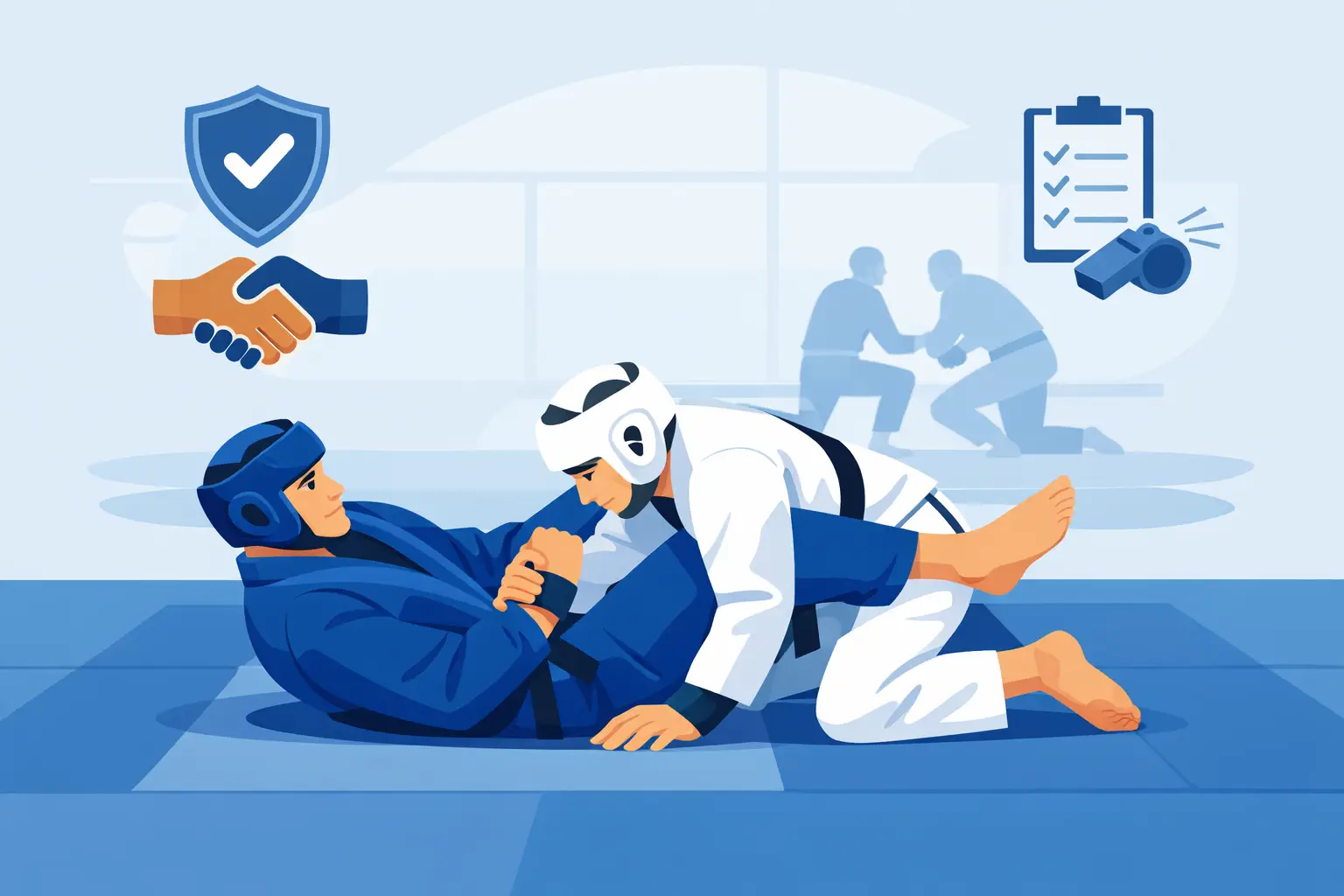
A coach usually notices safety problems before an injury happens. The room gets louder, rounds start faster than the athletes can process, newer students freeze in bad positions, and experienced students solve every task with speed and force. That is exactly where bjj training safety games matter - not as watered-down sparring, but as designed environments that keep learning productive while reducing unnecessary risk.
For coaches using a constraints-led approach, safety is not a separate lecture at the start of class. It is part of task design. The way you define space, scoring, starts, finishes, intensity, and allowable actions determines whether a game teaches clean decision-making or creates random collisions and panic responses. Safer sessions come from better structure, not just better reminders.
What bjj training safety games are really solving
In many academies, safety gets framed as athlete behavior. Tap early. Control your body. Respect your partner. All true, but incomplete. Coaches also need to manage the design variables that shape behavior under pressure.
A poorly built game can create predictable problems. If the objective is vague, athletes invent their own rules and often default to strength. If the space is too crowded, takedown entries become collision risks. If positional constraints are unclear, beginners may rotate through vulnerable joint configurations while trying to "win" a task they do not understand. The issue is not that games are unsafe. The issue is that undirected games expose weak coaching structure.
Well-designed safety games solve three coaching problems at once. They reduce chaotic movement, they channel attention toward the specific tactical problem you want solved, and they let athletes train with meaningful resistance at an intensity that matches their level. That is the real advantage. You are not removing realism. You are organizing it.
Start with risk design, not rule memorization
Most coaches begin by asking what safety rules to say out loud. A stronger starting point is asking what the athletes will actually be invited to do.
If a game begins from standing, what kind of entries are available? If athletes are escaping from turtle, can they launch blindly into neighboring pairs? If the game rewards fast top control, have you also created enough boundary awareness and enough space for scrambles? These are design questions, and they matter more than a generic "be careful" reminder.
A useful framework is to think in terms of exposure, velocity, and consequence. Exposure refers to how often athletes will encounter a risky scenario. Velocity refers to how fast they can enter it. Consequence refers to how much damage can happen if the movement goes wrong. A standing pummel game with constrained finishes has different safety demands than an open takedown round, even if both are technically "live."
For newer students, reduce all three. Limit exposure to complex transitions, reduce the speed of entries, and cap the consequence by starting in positions where the worst outcomes are less severe. For advanced athletes, you can increase realism, but only if the task still gives you control over those variables.
The best safety constraint is often a better objective
Coaches sometimes overcorrect by banning too many actions. That can make athletes passive and disconnected from the actual tactical problem. A better move is often to sharpen the objective.
Instead of saying, "No explosive movement," define the win condition so the athlete must stabilize before scoring. Instead of saying, "Don’t crank submissions," build a game where the goal is exposing alignment or isolating a limb, then reset before full finishing mechanics. Instead of saying, "Stay under control," require three seconds of connection after a sweep before points count.
This keeps the session representative while reducing the incentive for reckless behavior.
How to build safer games without making them artificial
The key is not to remove contact or uncertainty. It is to scale the problem so athletes can perceive, decide, and act inside a controlled environment.
Start position is your first lever. Beginning from seated guard, chest-to-chest half guard, mount, or rear body lock instantly removes layers of unpredictability. That matters for mixed-level rooms. You still get live decision-making, but without forcing every athlete to solve the whole sport at once.
Space is your second lever. Coaches often underestimate how much safer a class becomes when games have clear spatial limits. Wall-side rounds, lane-based movement, or fixed starting zones reduce drift and accidental collisions. This is especially useful for wrestling phases and scramble-heavy tasks.
Permitted actions are the third lever. If your learning goal is front headlock retention, there is no reason to leave every escape, roll, and re-attack available on day one. Constrain the menu. Let the defense work through two or three relevant exits, and let the attacker solve those. The athletes still experience resistance, but within a tactical frame that you can supervise.
Time is the fourth lever. Short rounds are safer when learning a new game because fatigue does not get to masquerade as toughness. A thirty-second or forty-five-second task often produces better decisions than a three-minute war, especially when the position is mechanically demanding.
Where coaches usually get safety wrong
The most common mistake is assuming that lower intensity automatically means lower risk. It depends on the game. Slow, confused movement in unfamiliar leg entanglements can be more dangerous than high-energy guard retention with clear rules and fast resets.
The second mistake is mixing too many levels in the same task without changing the conditions. If a new white belt and an experienced competitor are both told to start from open standing with broad scoring freedom, the coach has handed the stronger athlete too many ways to overwhelm the exchange. Scaling intensity is not enough. The task itself should change.
The third mistake is running a good game with poor operational control. Even a strong design can break down if athletes do not know when to reset, where to reset, or what counts as success. Clarity is a safety tool. Coaches should define the start, the score, the reset trigger, and the expected intensity before the first rep goes live.
BJJ training safety games by class context
Safety design should change based on who is on the mat and what phase of training you are running.
For fundamentals classes, the priority is reducing panic and preserving orientation. Positional games with obvious edges work best. Mount escape games, side control recovery tasks, seated guard retention, and controlled front headlock scenarios all allow resistance without overwhelming novices. The athletes learn where to look, where to post, when to connect, and when to stop.
For intermediate rooms, you can expand the action space, but transitions still need boundaries. This is where chained games are useful. An athlete escapes side control, connects to turtle or guard, and the round resets once the next stable position appears. You are training continuity, but not letting every scramble turn into open chaos.
For advanced classes, the challenge is usually not basic safety awareness. It is preventing competitive habits from distorting the learning task. If the game objective is too broad, skilled athletes will game the room rather than train the problem. More specificity often creates both better learning and safer rounds. Advanced does not mean unrestricted.
Safety is also a tracking problem
Most coaches can identify a game that feels off. Fewer can explain why it felt off in a way they can fix next week. That is where documentation matters.
If a certain task keeps producing collisions, rushed submissions, or positional confusion, the answer is not just to remove it from the curriculum. Track what happened. Was the starting position too open? Was the room spacing poor? Were reset conditions missing? Did the athletes need a simpler version first? Once you record those patterns, safety stops being reactive and becomes part of your class design process.
This is one reason structured coaching systems matter. When your games, lesson plans, and session notes live in one organized workflow, it becomes easier to refine constraints instead of reinventing class from memory. ConstraintCoach is built around that reality: better game design and better operational organization lead to better training outcomes.
A practical standard for safer live training
A useful test is simple. Before you run a game, ask whether the athletes will understand three things immediately: what problem they are solving, what actions are available, and when the exchange stops. If any of those are unclear, the game is probably carrying more risk than necessary.
From there, watch the first two rounds like a designer, not just a referee. If athletes are colliding, remove movement options or change spacing. If they are stalling, sharpen the scoring condition. If they are muscling through the task, make the objective require control instead of speed. Safety and learning quality usually move together.
The best rooms are not safe because they are soft. They are safe because the coach has built tasks that make productive behavior the easiest behavior to choose. That is the standard worth aiming for every time you put athletes into live work.