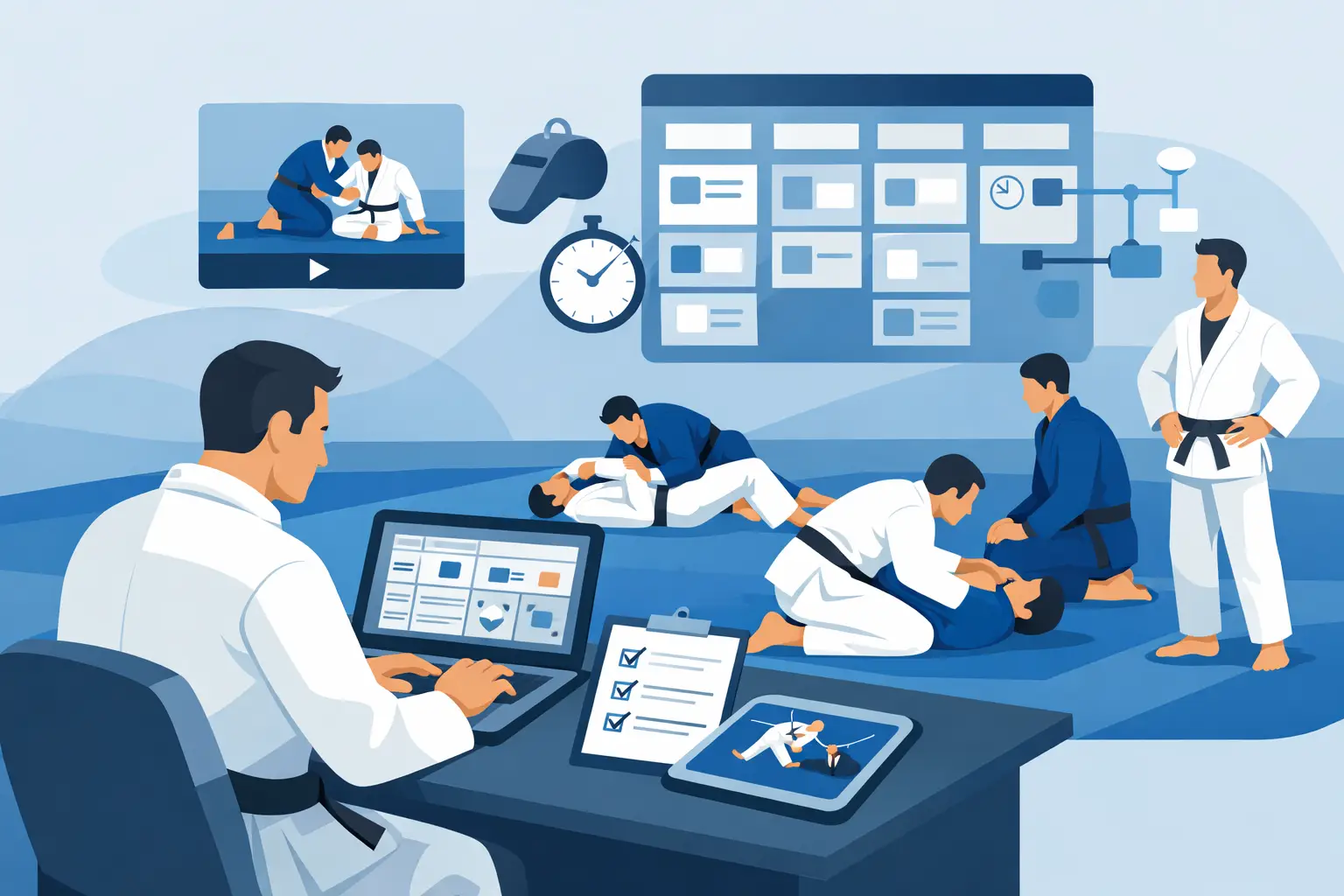
A good class usually looks smooth from the mat. The warm-up fits the room, the first task connects to the main game, athletes stay engaged, and the coach can actually teach instead of improvising every transition. What athletes do not see is how much structure sits behind that result. A bjj session planning tool matters because class quality is rarely just about coaching knowledge. It is about whether that knowledge is organized well enough to show up consistently.
For BJJ instructors running multiple classes, managing assistant coaches, or trying to build a more modern constraints-led program, planning breaks down fast when it lives in scattered notes, saved messages, and memory. One strong idea for a game is not the same as a repeatable session design system. If you want athletes to improve decision-making, timing, and adaptability, your planning process has to support that outcome.
What a BJJ session planning tool should actually do
Not every planning system deserves to be called a coaching tool. A generic calendar or notes app may store ideas, but that is different from helping you design a class. A real bjj session planning tool should support the way BJJ is taught, not just give you a blank space to type in.
At minimum, it should help you organize session objectives, structure activities in sequence, connect games to broader curriculum themes, and review what happened after class. For coaches using constraint-led methods, it should also make it easier to manage task design. That means tracking the constraints used, the tactical problem being presented, expected athlete behaviors, and how each game fits into a progression.
This is where many coaches get stuck. They understand the principles. They know static drilling alone is not enough. They want more representative training and better transfer. But the day-to-day work of building classes around those ideas becomes messy without a system. The tool is not there to replace coaching judgment. It is there to make judgment easier to apply under real conditions.
Why class planning fails without a system
Most planning problems are not really about a lack of effort. They are workflow problems.
A coach runs a strong passing session on Tuesday, but three weeks later cannot remember the exact constraints that made the game work. Another coach has a solid curriculum idea for front headlock development, but it never turns into a clean sequence across beginner, intermediate, and comp classes. An academy owner wants assistants teaching with more consistency, but each coach interprets the class goal differently because the plan is too vague.
Without a defined planning system, useful coaching information disappears. Session quality becomes overly dependent on memory and experience. That may be manageable for a single veteran coach teaching a few classes a week. It becomes much harder when you scale to multiple instructors, multiple levels, and a curriculum that is supposed to build over time.
There is also a hidden cost. Poor planning usually creates reactive coaching. Instead of evaluating athlete behavior, adjusting constraints, and refining task design, the coach spends mental energy deciding what comes next. That is attention that should be used on observation and intervention.
The difference between planning content and planning learning
This distinction matters. Many instructors plan content. Fewer plan learning.
Planning content means deciding the topic of the day. Passing from headquarters. Escaping mount. Arm drag to back exposure. That is useful, but incomplete. Planning learning means deciding what problem the athlete will face, what action opportunities will appear, what constraints will guide behavior, and how the session will create enough repetition with variation for adaptation.
A better bjj session planning tool supports that second layer. It helps you move beyond naming a position and toward designing an actual learning environment. For example, instead of writing "half guard passing," a stronger plan defines the tactical objective, the starting conditions, the scoring incentives, the reset rules, the asymmetry between players, and the coaching language you want assistants to reinforce.
That level of planning does not make class rigid. It makes it clearer. Athletes still explore. Coaches still adapt. But the session has a defined architecture.
How a BJJ session planning tool improves class delivery
The best planning tools improve teaching before class, during class, and after class.
Before class, they reduce setup friction. Coaches can pull from a library of proven games, review prior sessions, and build a session around a clear objective instead of starting from scratch. That is especially important if you teach often. Rebuilding every session manually is inefficient, and it increases inconsistency.
During class, the benefit is focus. When the session sequence is already organized, you can spend more time watching athletes, identifying movement solutions, and making useful task adjustments. You are less likely to over-explain or drift into unrelated content because the design is already anchored.
After class, the tool becomes a performance record. You can log what happened, note where athletes got stuck, record which constraints sharpened the intended behavior, and identify what should change next time. Over weeks and months, that gives you something most coaches do not have - a usable feedback loop on your own coaching process.
What serious coaches should look for in a planning workflow
The right workflow depends on the size of your program and how structured your coaching model is. Still, there are a few capabilities that consistently matter.
First, your session plans should connect to a broader curriculum. If each class exists in isolation, athletes may enjoy the room while making slower long-term progress. Strong planning links today’s game to a larger developmental track.
Second, you need reusability. Good games should not disappear after one class. A planning system should let you save, refine, and redeploy sessions with small adjustments for different athlete levels or class goals.
Third, you need coaching notes that are actually useful. Writing "class went well" tells you nothing. Better notes identify athlete responses, timing issues, pacing problems, and whether the task design created the behavior you wanted.
Fourth, if you work with other instructors, standardization matters. Shared plans reduce drift across classes and make it easier to align language, scoring, safety expectations, and progression logic.
This is one reason platforms built specifically for BJJ coaching have an advantage over general planning software. A specialized system can reflect the realities of grappling instruction rather than forcing coaches to adapt a generic tool into something workable.
Constraint-led coaching needs better planning infrastructure
Constraint-led training is often discussed as a philosophy, but for most gyms the real challenge is operational. Coaches do not struggle because they reject the approach. They struggle because they need a reliable way to build sessions around it.
Designing effective games takes more than a good concept. You need a clear objective, appropriate constraints, a manageable level of complexity, and enough progression options to respond to what happens in the room. You also need to know whether the game belongs in an intro class, an advanced room, or a competition-focused session.
That is why planning infrastructure matters so much for modern BJJ coaching. The more representative and adaptable your teaching model becomes, the less you can rely on rough notes and improvisation. A serious system helps you preserve good design, compare session outcomes, and build consistency across your program.
For coaches trying to implement ecological and constraints-led ideas at scale, that support is not a luxury. It is part of the teaching method itself.
When a simple tool is enough, and when it is not
There is a trade-off here. Not every coach needs a highly detailed planning environment.
If you teach one class a week, work with a small familiar group, and have a narrow instructional scope, a lightweight system may be enough. You may only need a place to organize themes and keep a few notes.
But once you are teaching across levels, building a curriculum, developing assistants, or trying to standardize a methodology, simple tools usually start to fail. They store information, but they do not structure it in a way that improves coaching operations. That is the key difference.
A dedicated platform like ConstraintCoach is useful in that context because it treats planning as part of instruction, not as separate admin work. The session library, curriculum structure, logs, and coaching workflow all support the same goal - more repeatable, better-designed classes.
That kind of system will not fix weak coaching ideas. It will, however, make strong coaching ideas easier to execute consistently, which is what most academies actually need.
Better planning creates better rooms
Athletes feel the effects of planning even if they never see the system behind it. They feel it when sessions progress logically, when games expose the right problems, when assistants teach the same model, and when class time is spent on training instead of on-the-fly organization.
For coaches, that is the standard worth building toward. A bjj session planning tool is not just about being more organized. It is about creating a coaching process that produces clearer sessions, better transfer, and fewer avoidable gaps between what you believe about learning and what actually happens on the mat.
The coaches who improve fastest are usually not the ones with the most ideas. They are the ones with a system strong enough to keep using their best ideas well.