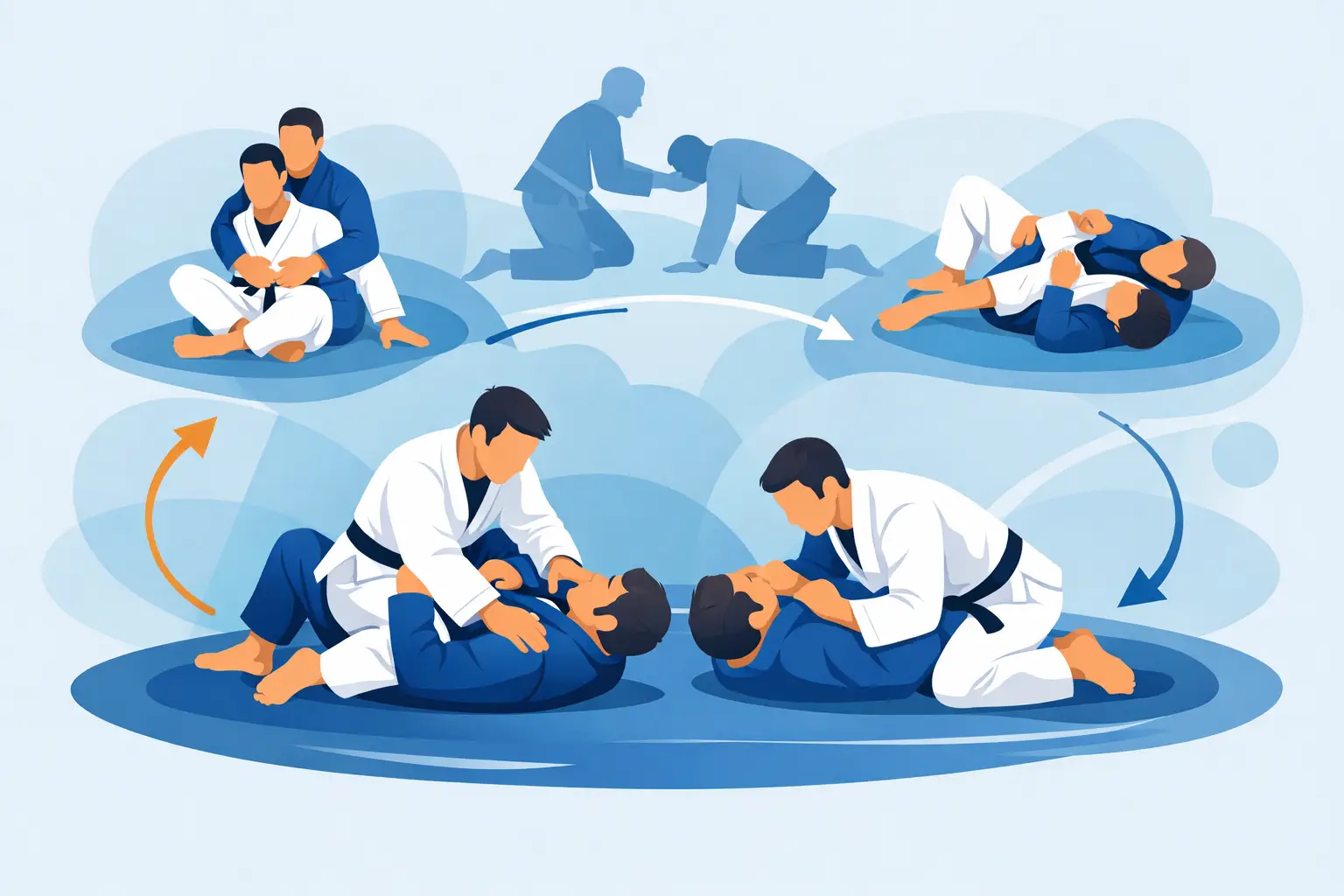
Most coaches have seen the same pattern. A class looks clean during drilling, but once rounds open up, athletes lose the position, miss the cue, or default to old habits. That gap is exactly why bjj positional games matter. They let you train the decisions inside a position, not just the shape of it.
For coaches working with a constraints-led approach, positional games are not a side tool or a warm-up add-on. They are a practical way to organize live learning around a specific tactical problem. Done well, they create focused variability, clearer intention, and much better transfer than static repetition.
What bjj positional games are really for
A positional game is not just sparring from a preset start. It is a designed task with specific constraints that channel attention toward a problem you want athletes to solve. The position gives you context. The rules shape behavior. The scoring or restart condition tells athletes what matters.
That distinction is important. If you put two people in headquarters and say, "go," you may get useful training, but you may not get targeted learning. If your goal is to improve off-balancing before passing, forcing chest-to-knee alignment, or exposing how the bottom player frames and recovers inside space, then the game needs to direct athletes there.
This is where many classes drift. Coaches use positions, but they do not actually design games. The result is broad intensity without enough informational focus. Athletes get tired, but the learning objective gets diluted.
Why positional games outperform isolated drilling in many classes
The main advantage of positional games is that they preserve perception and action together. Athletes are not rehearsing a move in a vacuum. They are reading resistance, adjusting timing, and making decisions under pressure. That is much closer to what actually happens in live jiu-jitsu.
There is also a coaching advantage. Games make it easier to scale challenge without changing the whole lesson. You can widen or narrow the task, change the scoring, limit grips, alter available reactions, or adjust the reset point. That gives you more control over the learning environment than a simple "drill then roll" format.
This does not mean isolated drilling has zero value. There are times when a short, low-resistance rep helps athletes understand orientation, safety, or the basic route of an action. But if that becomes the dominant teaching method, athletes often learn to reproduce a pattern without learning when and why it works.
The design principles behind useful bjj positional games
Good game design starts with the tactical problem, not the move list. Ask what the athlete must perceive, manage, or exploit in that position. Then build constraints that increase the likelihood of those behaviors emerging.
If you are teaching mount retention, the real problem is not "do mount escapes." It may be denying elbow-knee connection, climbing exposure, or choosing between chest pressure and mobility based on the bottom player’s bridge direction. A useful game isolates that tactical exchange without making it artificial.
Your constraints should answer four practical questions. Where does the round start? What are players trying to achieve? What actions are limited or emphasized? When does the round reset?
The most effective games usually stay simple. One clear objective per athlete is often enough. Once you stack too many rules, the game starts to feel like choreography. The athlete begins thinking about compliance instead of solving the problem.
How to build a positional game from a coaching objective
Start with the position, but define it narrowly. "Side control" is often too broad. Near-side underhook side control against a framing bottom player is more specific and easier to coach.
Then identify the win conditions. Top player may score by advancing to mount or isolating a far-side arm for three seconds. Bottom player may score by recovering inside knee position or returning to seated guard. Those outcomes create direction.
After that, shape the environment with one or two constraints. Maybe the top player cannot switch sides for the first exchange. Maybe the bottom player cannot bench press the frame and must recover through hip movement. Maybe both athletes restart if the head escapes alignment. These are not arbitrary rules. They are there to highlight the information you want athletes to read.
Finally, decide how long the round should be. Short rounds work well when intensity and decision density are high. Thirty to sixty seconds is often enough for clear, repeatable exchanges. Longer rounds can help once athletes understand the game and need more continuity.
Examples that actually fit class planning
A strong class uses positional games as part of a progression, not as disconnected rounds.
If the theme is passing against knee shield, your first game might start with top player inside range but without chest connection. The task is to win upper-body alignment before passing. That focuses athletes on hand fighting, shoulder position, and angle management. The second game can begin with established chest connection, where top player scores by clearing the knee line and bottom player scores by rebuilding the shield or returning to seated guard. The third game can open the constraints slightly and allow more passing routes while keeping the same tactical focus.
The point is not variety for its own sake. The point is sequencing. Each game should solve a piece of the larger problem and prepare athletes for the next level of complexity.
This is where organized coaching systems matter. If you are designing classes week after week, you need a way to document the exact game, the objective, the constraint, and what happened in training. Otherwise, useful session design turns into memory and guesswork.
Common mistakes coaches make with positional games
The first mistake is making the game too open too soon. If everything is available, the athletes often bypass the exchange you wanted to teach. You end up observing general skill, not developing a specific one.
The second mistake is overconstraining the game. When athletes feel trapped in a narrow script, they stop adapting. The game may produce the appearance of clean reps, but the behavior does not transfer well because the athlete never had to solve a live problem.
The third mistake is unclear scoring. If players do not understand what counts as success, the round loses direction. They may train hard, but not with enough intention.
The fourth mistake is ignoring role asymmetry. Top and bottom players do not need equal freedom for the game to be useful. In fact, uneven constraint is often the point. One athlete may need a narrower problem while the other supplies the right kind of resistance.
How to coach the room while games are running
During positional games, coaching should stay tightly connected to the task. Broad technical speeches usually miss the moment. What works better is brief, targeted feedback tied to the athlete’s attention.
You might cue the passer to win head position before chasing the leg. You might remind the defender to recover inside space before trying to stand. These cues are effective because they fit the game’s objective.
It also helps to watch for repeated failures in the same place. If five pairs keep stalling at the same exchange, that is not a room problem. It is a design signal. The task may need a better reset point, a simpler scoring rule, or a narrower starting position.
For serious instructors, this is where coaching becomes operational rather than improvisational. You are not just delivering techniques. You are running a training system, evaluating task design, and refining future sessions based on what the room shows you.
Using bjj positional games across experience levels
Beginners usually need tighter starting positions and simpler objectives. They benefit from games that reduce chaos and make success legible. A new athlete can learn a lot from a short game where the only goal is to recover elbow-knee connection from mount.
Advanced athletes often need the opposite. They may require broader affordances, layered scoring, or asymmetrical tasks that expose adaptation under uncertainty. The same position can serve both groups, but the game design should change.
That is why reusable coaching frameworks are more valuable than random game collections. A good library helps you scale the same tactical theme up or down without rebuilding the class from scratch. ConstraintCoach approaches this as a planning problem as much as a teaching problem, which is the right frame for coaches who want consistency across sessions and staff.
The real value for your program
BJJ positional games are not just a better way to fill the middle of class. They give your program a repeatable method for teaching decision-making inside live exchanges. That matters if you want athletes who can adapt, not just imitate.
The deeper benefit is organizational. Once your games are designed around clear objectives, your curriculum gets easier to structure, your assistant coaches can deliver sessions more consistently, and your review process becomes more honest. You can see what the room is actually learning.
If your classes still rely on clean-looking reps followed by messy sparring, positional games are often the missing layer. Build them around real tactical problems, keep the constraints purposeful, and let the room teach you what to refine next.