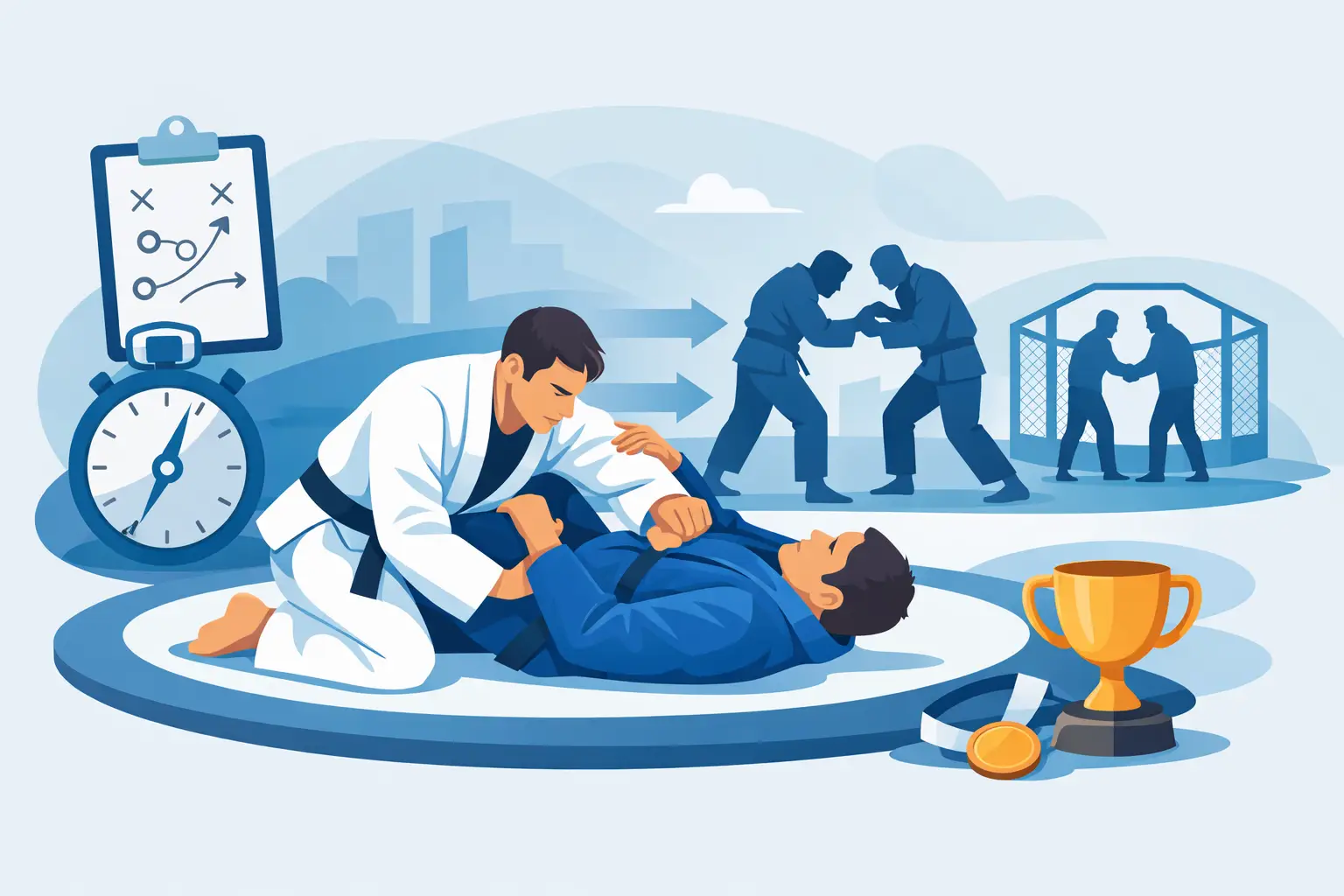
If your students look sharp in isolated reps but lose the thread the moment resistance goes live, the problem usually is not effort. It is training design. BJJ game based training has become more relevant for coaches who want athletes to make better decisions under pressure, not just reproduce clean-looking movements in low-information settings.
That shift matters because jiu-jitsu is not performed in static pieces. It is performed in changing situations with timing, uncertainty, opponent reactions, and constant trade-offs. A student does not need to remember a sequence in the abstract. They need to detect what is available, act on it quickly, and adjust when the environment changes.
For coaches, that means class design has to move beyond asking, "Can they copy this technique?" A better question is, "Can they solve this problem against resistance in a way that resembles the real task?" Game-based training is one of the most practical ways to build classes around that question.
What bjj game based training actually is
At its best, bjj game based training is not random sparring with a catchy label. It is a structured way to shape learning through constraints, objectives, scoring conditions, space limits, starting positions, and task rules. The coach defines the problem clearly enough that useful behaviors emerge, while still leaving room for athletes to find solutions.
That distinction is important. A game is not just "start in half guard and go." A game has a purpose. Maybe the bottom player scores by winning inside position and coming up on a single. Maybe the top player scores by flattening the hips and clearing the knee line. Maybe one athlete has a time constraint, or one side is not allowed to disengage. The design directs attention toward the tactical and mechanical information that matters.
This is where many coaches either get strong results or create confusion. If the game is too open, newer students cannot find the problem. If it is too scripted, you are back to a disguised drill. Good game design sits in the middle. It narrows the search enough to make learning visible, but it preserves the live perception-action loop that jiu-jitsu actually demands.
Why game-based classes transfer better
Transfer is the standard that matters. Not whether students enjoyed class, and not whether the room looked organized. Those are useful, but secondary. The real question is whether today’s practice improves tomorrow’s grappling.
Static drilling often struggles here because it removes the very information athletes need in competition or open rolling. Timing, defensive reactions, grips that shift, fatigue, and imperfect entries are not side issues. They are the task. When those elements are stripped away for most of class, students can become technically familiar without becoming functionally effective.
Game-based training keeps more of the task intact. Students still repeat actions, but they repeat them in context. They learn what triggers the movement, what resistance changes it, and what backup option appears when the first solution closes. That is why decision-making often improves faster in well-designed games than in traditional move-of-the-day formats.
There is a trade-off, though. Games can look messier. Coaches who value visual neatness may initially feel that learning is less controlled. In reality, the opposite can be true. The class may be less uniform, but the athlete behavior is often more honest. You get better information about what students can actually perceive, attempt, and recover under pressure.
How to build a useful BJJ game based training session
A strong session starts with one problem, not six. If the focus is passing headquarters, the class should not also wander into leg drag variations, back takes, and unrelated submission chains unless those outcomes are tightly connected to the central task. Most coaches improve their sessions by reducing scope.
Start with the tactical objective. What are you trying to help athletes solve? Then define what successful action looks like for both sides. In a passing game, the top player might be working to win chest-to-knee connection and clear the bottom player’s frames. The bottom player might be working to recover inside position or create enough angle to stand.
Once the objective is clear, set the constraints. This is where the training environment becomes useful instead of generic. You can limit the space, fix the starting grips, assign score values to specific wins, restrict resets, or create asymmetry between athletes. Each choice should make the target behavior more likely to appear.
Then coach the room around attention, not just correction. Instead of only telling athletes what movement to perform, direct them toward the information they should detect. Ask what they feel when the knee line is exposed. Ask what changes when the crossface becomes stable. Ask when a post is late. This helps athletes organize their actions around relevant cues instead of memorized choreography.
Finally, sequence your games so they progress logically. Early games should reduce complexity without removing the core problem. Later games can widen the decision space. That progression gives students enough stability to improve while still preserving the live nature of the task.
Common mistakes coaches make with game-based training
The first mistake is confusing intensity with quality. A game can be live and still poorly designed. If athletes are just scrambling without a clear success condition, you may get effort but not meaningful adaptation.
The second mistake is using too many rules. Coaches sometimes overbuild games because they want to force the right answer. Usually that creates hesitation and cognitive clutter. If athletes need a long explanation to start training, the task probably needs simplification.
The third mistake is failing to connect games to a broader curriculum. One good game can improve a class. A structured bank of related games can improve a program. If your passing games, retention games, front headlock games, and standing entries are all isolated from each other, athletes may have engaging sessions without a coherent development pathway.
This is where coaching systems matter. Serious instructors need more than good ideas in the moment. They need a way to organize games by position, theme, athlete level, and progression so that class quality does not depend on memory or improvisation.
When bjj game based training works best
It works especially well when the coach is trying to improve timing, adaptability, and tactical understanding. It is also effective for mixed-level rooms because constraints can be adjusted without changing the central problem. A beginner and an advanced athlete can work from the same game if the scoring, start position, or permitted actions are scaled appropriately.
It is also useful when a coach wants cleaner assessment. In a traditional class, it can be hard to tell whether a student understands a position or is simply reproducing a pattern they saw two minutes earlier. In a game, the athlete has to show what they can actually do when the problem pushes back.
That said, it depends on the athlete and the coaching environment. Very new students may still benefit from short windows of demonstration and pattern exposure, especially when safety or basic orientation is a concern. The point is not to pretend every training problem has one method. The point is to use enough structure and live context that learning remains connected to performance.
Building a repeatable coaching system around games
The coaches who get the most from this approach usually do not treat games as occasional variety. They build them into a repeatable operating system. That means tracking which games were used, what behaviors emerged, where athletes got stuck, and how the task should progress next week.
Once you start working this way, class planning becomes less about inventing content and more about managing a development process. You can map games to curricular themes, preserve session notes, and refine constraints based on actual athlete response. Over time, your room becomes more consistent because your coaching design becomes more consistent.
That is one reason platforms like ConstraintCoach are useful for serious instructors. The value is not just access to game ideas. It is having a centralized structure for organizing a library, planning sessions, logging what happened, and building a standard your staff can actually repeat.
For coaches trying to modernize their instruction, this is the real shift. BJJ game based training is not a trend to layer on top of an old planning model. It is a different way to think about class design, athlete feedback, and curriculum control. When the games are well built and the workflow is organized, students stop practicing around the skill and start practicing the skill itself.
The best test is simple: if your training design creates better decisions under live pressure, keep building on it. If it produces clean reps that disappear in real exchanges, the room is telling you something worth listening to.